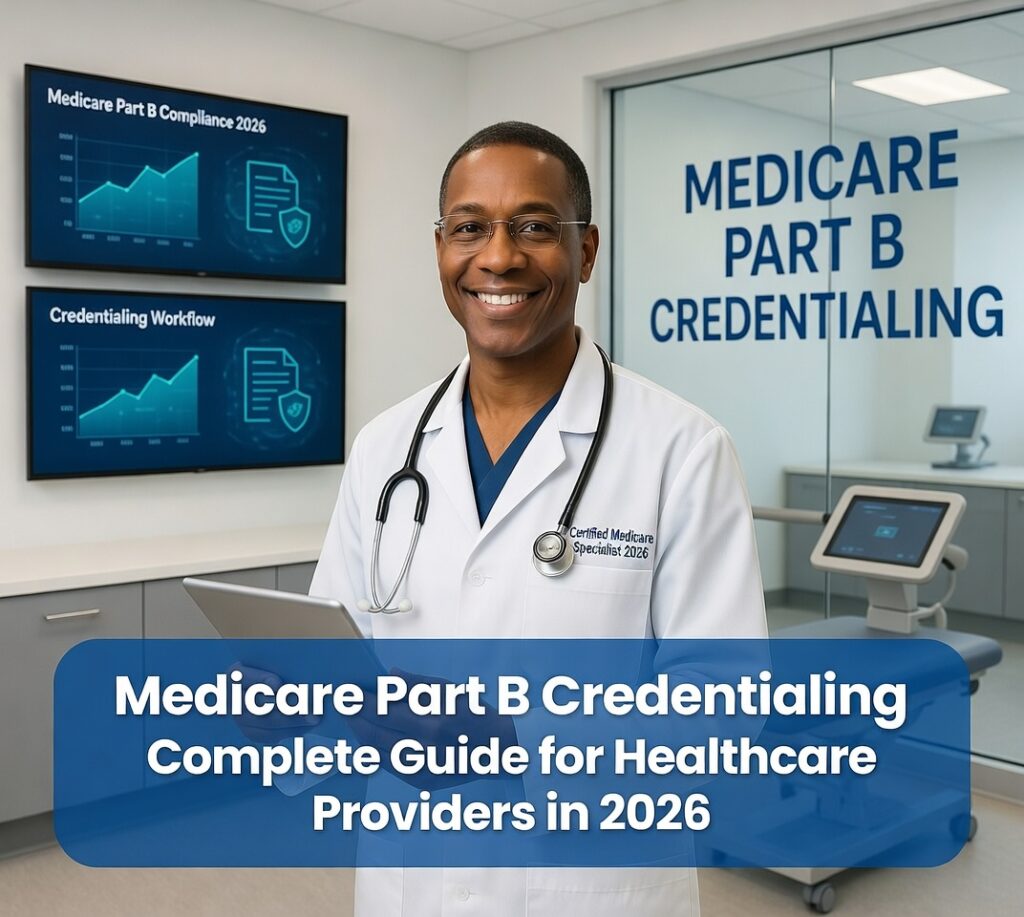
Medicare Part B Credentialing Complete Guide for Healthcare Providers
What is Medicare Part B Credentialing?
Medicare Part B credentialing is the process of enrolling your healthcare practice with Medicare so you can bill for outpatient services such as physical therapy, physician visits, and preventive care. It requires submitting detailed information through CMS (like the CMS-855 forms), verifying provider qualifications, linking NPIs, and ensuring compliance with strict federal guidelines. This process is very important for healthcare providers of USA because without proper Part B credentialing, providers cannot receive reimbursement for services delivered to Medicare patients.
At East Billing, we handle Medicare Part B credentialing with a strategic, detail-focused approach, we minimize errors, prevent your rejections, and accelerate approvals. Our experts manage everything from application submission to payer follow-ups, helping your practice get credentialed faster and start generating revenue without unnecessary delays or compliance risks. Medicare Part B Credentialing
High Claim Denial Rates Linked to Incorrect Medicare Part B Credentialing
Incorrect Medicare Part B credentialing is a major driver of claim denials for healthcare practices across the nation in 2026. Industry benchmarks show that 18%–26% of Part B claims are denied initially, and a notable portion stems from enrollment and credentialing issues such as inactive PTANs or mismatched provider records in the Medicare system.
When providers are not properly credentialed under Medicare Part B, claims are automatically rejected by Medicare even if services are medically necessary and correctly coded. This leads to delays, increased rework, and administrative strain for your healthcare practice.
Accurate credentialing ensures providers are authorized to bill, reducing denial rates and improving first-pass claim acceptance. Medicare Part B Credentialing Services
Revenue Leakage in Medicare Part B Billing Due to Credentialing Errors
Credentialing errors directly impact revenue by causing denied or delayed reimbursements. Research indicates that healthcare practices lose 5%–12% of annual revenue due to billing inefficiencies, with credentialing issues being a key contributor in this matter.
For example, if your healthcare practice is generating $750,000 annually under Medicare Part B could lose $37,500–$90,000 per year due to avoidable credentialing errors. These losses often go unnoticed because they are spread across multiple denied or delayed claims. Medicare Physical Part B Credentialing Experts
Common Medicare Part B Credentialing Mistakes And Their Financial Impact
Providers in the USA frequently make critical mistakes during Medicare Part B credentialing, including incorrect NPI submission, outdated practice locations, missing documentation, and improper provider type selection.
Another common issue is failing to properly link individual providers with group practices, which results in billing complications. These errors lead to claim denials, application rejections, and prolonged approval timelines.
The financial impact includes lost revenue, increased administrative workload, and delayed practice growth.
Medicare Part B Enrollment Delays and How They Affect Provider Revenue
Medicare Part B enrollment typically takes 60 to 120 days, but errors can extend this timeline significantly in all states of the USA. During this period, you cannot bill Medicare for services rendered.
This delay affects both revenue and patient access, as many patients rely on Medicare coverage. Your practice may lose potential patients or delay care due to credentialing issues.
Streamlined and accurate credentialing processes help reduce delays and allow faster onboarding into Medicare billing.
What Are Compliance Risks in Medicare Part B Credentialing?
Improper credentialing can trigger compliance issues under Medicare Part B regulations. It is necessary for your practice to meet CMS requirements, and any discrepancies can lead to audits or penalties.
Consequences may include payment recoupments, fines, or even exclusion from Medicare programs. Even minor data inconsistencies can raise compliance concerns during audits.
Maintaining accurate credentialing records ensures compliance and protects providers from legal and financial risks.
Revalidation and Credentialing Gaps and Hidden Threats to Medicare Part B Billing
Medicare requires form providers to revalidate their enrollment every 5 years, or sooner if requested. Failure to complete revalidation leads to deactivation of billing privileges.
Credentialing gaps occur when providers fail to track deadlines or update their information. Once deactivated, you need to reapply, causing significant delays in billing and revenue loss. Proactive monitoring and timely updates are essential to maintain uninterrupted billing.
Medicare Part B Claim Denial Statistics (2024–2026 Trends)
Medicare Part B claim denial rates are steadily rising, increasing from 20% in 2024 to a projected 25% in 2026, with credentialing-related denials also showing a significant upward trend. At the same time, first-pass acceptance rates are declining while rework requirements continue to grow, emphasizing the need for accurate credentialing and efficient billing processes.
| Metric | 2024 | 2025 | 2026 (Projected) |
|---|---|---|---|
| Average Part B Denial Rate | 20% | 22% | 25% |
| Credentialing-Related Denials | 7% | 9% | 11% |
| First-Pass Acceptance Rate | 80% | 78% | 75% |
| Claims Requiring Rework | 68% | 72% | 76% |
Revenue Loss Due to Medicare Part B Credentialing Errors by Practice Size
Credentialing errors in Medicare Part B can lead to significant financial losses across all practice sizes, with small practices losing around $30,000 annually and larger practices exceeding $60,000 in losses. While the percentage loss may decrease for larger practices, the overall revenue impact remains substantial, making accurate credentialing essential for financial stability.
| Practice Size | Annual Revenue Range | Avg. Loss % (Credentialing Errors) | Estimated Annual Revenue Loss | Key Risk Factors | Operational Impact |
|---|---|---|---|---|---|
| Small Practice | $250K – $400K | 9% – 11% | $25K – $40K | Limited billing staff, manual processes | Cash flow instability, delayed reimbursements |
| Mid-Size Practice | $500K – $900K | 7% – 9% | $40K – $75K | Scaling issues, inconsistent compliance | Increased denial rates, rework costs |
| Large Practice / Group | $1M – $3M+ | 5% – 7% | $60K – $150K+ | Complex provider networks, multi-location errors | High volume denials, compliance exposure |
Enrollment Delay vs Financial Impact in Medicare Part B Billing
Enrollment delays in Medicare Part B billing can significantly impact revenue, with losses ranging from $10,000–$15,000 for a 30-day delay and reaching up to $50,000 for delays extending to 90 days. These increasing losses highlight how prolonged enrollment timelines can disrupt cash flow and hinder overall practice growth.
| Delay Duration | Estimated Revenue Loss | Avg. Monthly Billing Affected | Primary Cause of Delay | Financial & Operational Impact |
|---|---|---|---|---|
| 30 Days | $10,000 – $15,000 | $12K – $20K | Incomplete application, documentation errors | Initial cash flow disruption, delayed reimbursements |
| 60 Days | $20,000 – $30,000 | $20K – $35K | Processing backlogs, re-submissions | Increased claim backlog, operational stress |
| 90 Days | $35,000 – $50,000+ | $35K – $60K | Credentialing errors, compliance issues | Severe revenue loss, risk to practice sustainability |
What Will Be the Impact of Incorrect NPI, PTAN, and Taxonomy Data on Medicare Part B Claims?
Accurate provider identifiers are critical for Medicare Part B billing. Errors in NPI, PTAN, or taxonomy codes result in automatic claim rejection due to mismatched records.
Even minor discrepancies can disrupt billing workflows and delay reimbursements. Ensuring consistency across all provider data is essential for successful claim processing.
How Incomplete Applications Cause Medicare Part B Credentialing Delays
Incomplete applications are a major cause of credentialing delays. Missing documentation, such as licenses or IRS forms, leads to rejection or requests for additional information.
Each correction extends the processing timeline, delaying provider enrollment and revenue generation. Submitting complete and accurate applications reduces turnaround time significantly.
Medicare Part B Credentialing vs Enrollment and the Key Differences
Many providers misunderstand the difference between credentialing and enrollment. Enrollment involves registering with Medicare, while credentialing verifies provider qualifications and billing eligibility.
Confusion between the two processes leads to incomplete submissions and billing issues. Understanding both ensures proper setup and seamless billing operations.
How Improving First-Pass Claim Acceptance Through Accurate Credentialing
Accurate Medicare Part B credentialing improves first-pass claim acceptance rates to 90% or higher, compared to lower rates in practices with errors.
Higher acceptance rates reduce administrative workload, improve cash flow, and enhance operational efficiency. This allows you to focus on patient care rather than claim corrections.
What Credentialing Challenges in Multi-Provider and Multi-Location Practices?
Managing credentialing across multiple providers and locations increases complexity. Each provider-location combination must be correctly enrolled and linked.
Errors in this process can lead to claim denials and revenue leakage across multiple sites. Proper credentialing management supports scalable growth and consistent billing.
What Are Best Practices for Error-Free Medicare Part B Credentialing?
To ensure accurate credentialing, you need to maintain updated records, verify all data before submission, and track application status regularly.
Implementing standardized workflows, checklists, and periodic audits helps reduce errors and improve efficiency. Proper documentation and timely updates are key to success.
Benefits of Outsourcing Medicare Part B Credentialing
Outsourcing credentialing to experts can reduce error rates by 30%–50% and speed up approval timelines. Experienced professionals ensure accurate submissions and compliance with Medicare requirements.
This approach allows providers to focus on patient care while improving revenue cycle performance and reducing administrative burden. Medicare Credentialing Services
In-House vs Outsourced Medicare Part B Credentialing Performance
In-house Medicare Part B credentialing often leads to higher error rates, longer approval timelines, and increased administrative burden, which can negatively impact your revenue cycle and delay reimbursements. By outsourcing to East Billing,you benefit from expert-driven accuracy, faster approvals, reduced denial rates, and streamlined processes, resulting in improved cash flow and overall operational efficiency.
| Performance Metric | In-House Credentialing | Outsourced to East Billing | Performance Impact |
|---|---|---|---|
| Error Rate | 18% – 25% | 6% – 10% | ⬇ Significant reduction in costly mistakes |
| Approval Time | 90 – 120 Days | 60 – 85 Days | ⬇ Faster enrollment & quicker reimbursements |
| Denial Rate | Higher (Frequent rejections) | Lower (Clean submissions) | ⬇ Improved claim acceptance rates |
| Administrative Burden | High (Staff overload) | Low (Fully managed) | ⬇ Frees up internal resources |
| Compliance Accuracy | Variable | High (Expert-led) | ⬆ Reduced compliance risks |
| Scalability | Limited | Flexible & scalable | ⬆ Supports practice growth |
| Cost Efficiency | High overhead costs | Cost-effective solution | ⬆ Better ROI |
Financial Impact of Medicare Part B Credentialing Errors
A healthcare provider delayed Medicare Part B credentialing by 60 days, resulting in a revenue loss of approximately $30,000.
Additionally, multiple claims were denied due to incorrect provider data, increasing administrative workload and delaying payments further. This highlights the importance of accurate credentialing.