What Is DentaQuest and Why Getting Credentialed With Them Is a Major Opportunity for Your Practice?
Understanding DentaQuest's Credentialing Authority, NCQA Standards, and the Sun Life Connection
| Credentialing Oversight Layer | Details |
|---|---|
| NCQA Guidelines | All credentialing activities follow NCQA standards as applied to dentistry. |
| CMS Compliance | Mandatory for Medicaid and Medicare Advantage lines of business. |
| State Regulatory Compliance | Each state adds its own licensing and documentation rules. |
| Credentialing Committee | Final approval or denial decisions are made by a formal committee. |
| Primary Source Verification | All credentials are verified through original primary sources. |
| OIG & Sanctions Screening | Exclusion checks, sanctions screening, and malpractice history review. |
| CAQH ProView Integration | CAQH is the primary provider data source in many states. |
Who Qualifies for DentaQuest Credentialing? Provider Types and Eligibility
DentaQuest credentials a broad range of dental professionals. Whether you are a general dentist, a specialist, a dental hygienist, or a group practice entity, you must complete credentialing before you can treat DentaQuest members and bill for those services.
Provider Types Eligible for DentaQuest Credentialing
| Provider Type | Credentialing Required | Key Eligibility Notes |
|---|---|---|
| General Dentist (DDS / DMD) | Yes | Primary credentialing category; covers Medicaid, Medicare Advantage, and commercial plans. |
| Endodontist | Yes | Board certification or active pursuit of board certification is typically required. |
| Oral and Maxillofacial Surgeon | Yes | Active DEA and CDS registrations are generally required where applicable. |
| Periodontist | Yes | Specialty certification and supporting documentation must be provided. |
| Prosthodontist | Yes | Specialty certification documentation is required during review. |
| Pediatric Dentist | Yes | Additional Medicaid and CHIP participation requirements may apply by state. |
| Orthodontist | Yes | Specialty certification and licensure verification are required. |
| Dental Hygienist (RDH) | Yes (State-Dependent) | May require separate credentialing depending on state regulations and payer rules. |
| Group Practice / Dental Entity | Yes | Requires group enrollment plus credentialing of every affiliated provider. |
The Complete DentaQuest Credentialing Document Checklist
One of the most consistent reasons DentaQuest credentialing applications are delayed is incomplete documentation. DentaQuest explicitly states,and every experienced credentialing professional will confirm, that incomplete applications delay the credentialing process without exception.Here is everything you need to gather before your application is submitted:
Universal Documents Required for Every Individual Provider
| Document | Requirement | Critical Notes |
|---|---|---|
| Current State Dental License | Active, unrestricted, non-expired | Must be valid for every state in which the provider is applying. |
| NPI (Type 1 — Individual) | Correct taxonomy code | Must match all submitted documents and CAQH data exactly. |
| W-9 Form | Signed and dated | Tax Identification Number (TIN) must match across all credentialing records. |
| Professional Liability (Malpractice) Insurance Certificate | Current with required coverage limits | Coverage must remain active throughout the credentialing process. |
| Credentialing Application | Fully completed and signed | Application signature generally must not be older than 120 days. |
| Curriculum Vitae (CV) | Complete work and education history | No unexplained gaps; all practice locations should be included. |
| Work History | Minimum 5 years in month/year format | Employment gaps of 6 months or longer require written explanation. |
| DEA Certificate | If applicable to specialty | Submit active DEA registration or a documented DEA waiver when permitted. |
| State Controlled Dangerous Substance (CDS) Certificate | If applicable | Requirements vary by state and should be verified before submission. |
| Government-Issued Photo ID | Driver's license or passport | Must be current, valid, and non-expired. |
| CAQH ProView Application | Fully completed and attested | DentaQuest accesses CAQH directly; profile must be current and authorized. |
| Provider Service Agreement | DentaQuest-specific contract form | State-specific agreement versions may be required. |
| Board Certification or Proof of Eligibility | If board-certified | Required for specialists; active pursuit may be accepted within approved timeframes. |
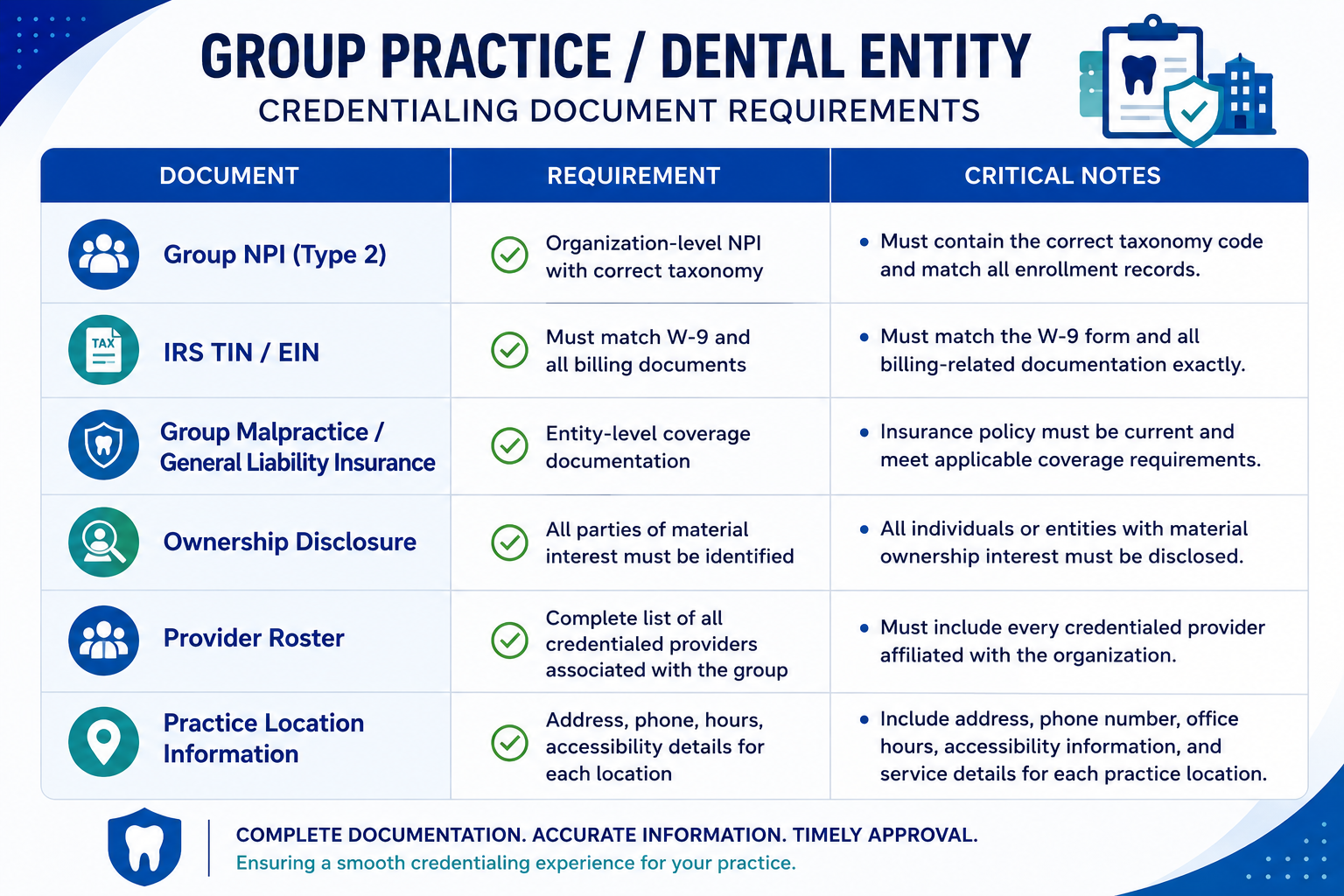
Additional Documents for Group Practices
State-Specific Additional Documents
DentaQuest operates across 30+ states and many require documentation beyond the universal checklist. Always request the state-specific contracting and credentialing package from DentaQuest’s provider relations team or download it from your state’s DentaQuest provider microsite before submitting.
How DentaQuest's Credentialing Process Works
DentaQuest Credentialing Workflow
| Step | Action | Key Details |
|---|---|---|
| Step 1 | Enroll in State Medicaid | Required before submitting a DentaQuest application for Medicaid lines of business. |
| Step 2 | Set Up or Update CAQH ProView Profile | Profile must be fully completed, attested, and authorized for DentaQuest access. |
| Step 3 | Submit Credentialing Application | Submit online through the provider portal; paper applications may be available through Provider Relations. |
| Step 4 | Submit Supporting Documents | All required documents must be included. Incomplete applications are typically not processed. |
| Step 5 | Completeness Review | Initial review confirms that all required forms and documentation are present. |
| Step 6 | Primary Source Verification (PSV) | Verification of licenses, malpractice coverage, board certifications, NPDB records, OIG status, and sanctions. |
| Step 7 | Background & Sanctions Screening | Reviews may include OIG exclusions, SAM database checks, and applicable state exclusion databases. |
| Step 8 | Credentialing Committee Review | Committee evaluates the complete file and determines approval, conditional approval, or denial. |
| Step 9 | Written Notification | Providers receive written notice regarding the credentialing decision. |
| Step 10 | Directory Activation & Contracting | Approved providers are activated in the network and listed in the provider directory. |
| Step 11 | EFT & ERA Setup | Electronic payment and remittance enrollment should be completed before claim submission. |
How Long Does DentaQuest Credentialing Take? Real Timeline Expectations
This is where providers need to pay particularly close attention. DentaQuest’s stated credentialing timeline and the real-world experience of dental providers can differ significantly.
DentaQuest’s standard credentialing process typically takes 30–90 days for a clean, complete application. However, documented provider experiences, including formal complaints filed with state Medicaid agencies, have described credentialing timelines extending from four months to as long as six to twelve months in cases involving application processing issues, lost applications, or high volume periods.
DentaQuest Credentialing Timeline Breakdown
| Phase | Estimated Duration | Key Variables |
|---|---|---|
| Medicaid Enrollment (If Required) | 15–60 Days | State Medicaid processing timelines and enrollment requirements. |
| CAQH Profile Setup or Update | 3–7 Days | Provider responsiveness, profile completion, and attestation status. |
| Document Gathering & Application Preparation | 5–10 Days | Availability and completeness of provider documentation. |
| Submission & Completeness Review | 1–5 Days | Whether all required forms and supporting documents are included. |
| Primary Source Verification (PSV) | 10–30 Days | Data accuracy and response times from licensing boards and verification sources. |
| Background & Sanctions Screening | 5–15 Days | OIG, NPDB, SAM, and state database processing timelines. |
| Credentialing Committee Review | 7–21 Days | Committee meeting schedules and complexity of the application. |
| Approval Notification & Contracting | 5–10 Days | Contract review, execution, and provider signature turnaround. |
| Provider Directory Listing | 5–10 Days After Activation | Internal system update and directory publication schedules. |
| Total (Clean, Complete Application) | 30–60 Days | All documentation is accurate, complete, and submitted correctly on the first attempt. |
| Total (Incomplete or Issues Present) | 90–180+ Days | Missing documents, correction requests, verification delays, or resubmissions. |
DentaQuest Re-credentialing and What You Must Know
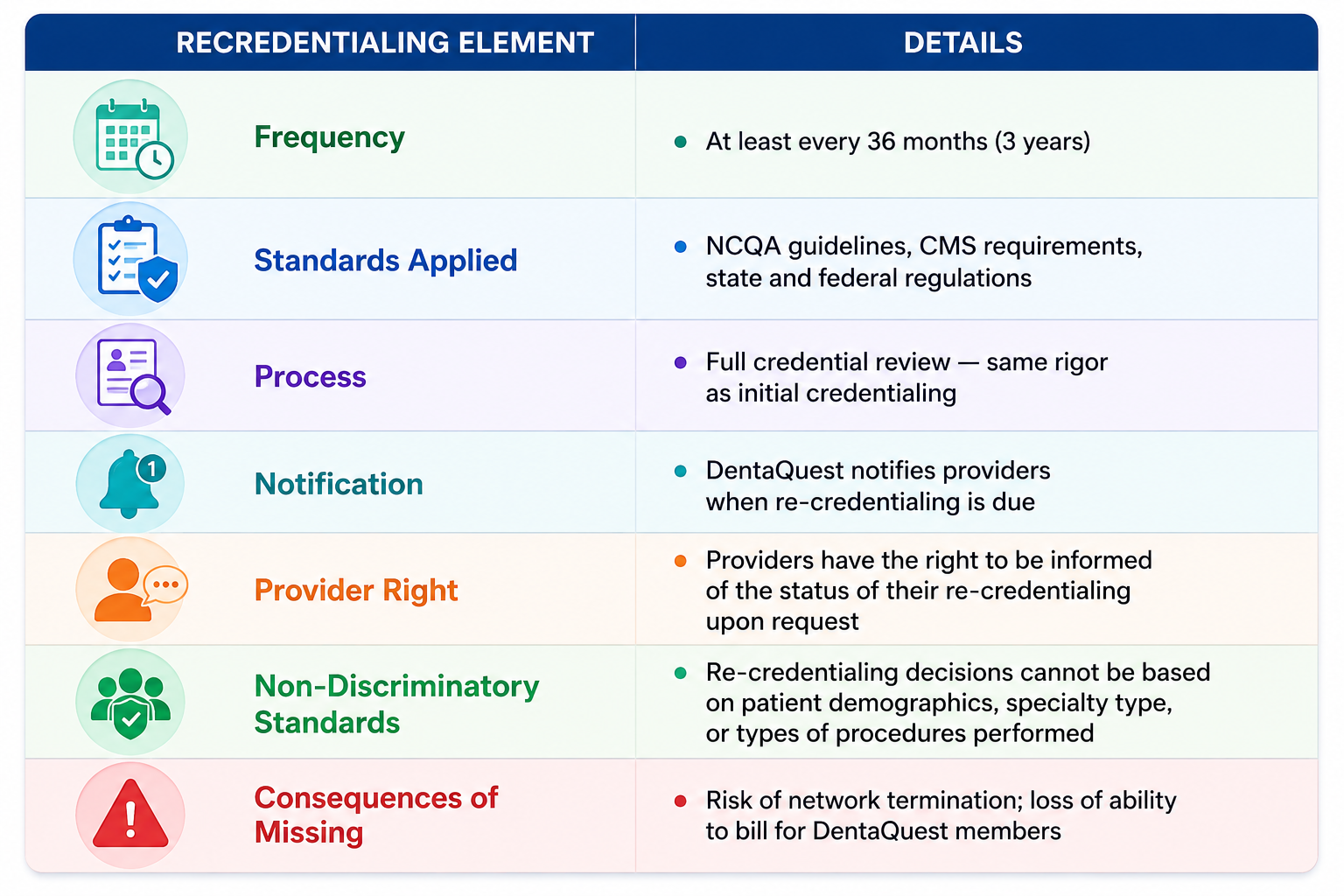
Credentialing is not a one-time event. In accordance with NCQA guidelines, DentaQuest requires all network providers to undergo re-credentialing at least every 36 months (three years). This is a full file review,, not a simple form update, and it carries the same documentation standards as initial credentialing.
DentaQuest Recredentialing Key Facts
DentaQuest and CAQH ProView — Why Your Profile Is the Foundation of Everything
CAQH ProView and DentaQuest: What Providers Must Understand
| CAQH Requirement | Impact on DentaQuest Credentialing |
|---|---|
| Profile Completeness | DentaQuest pulls data directly from CAQH. Any missing information creates a gap in credentialing. |
| Attestation Every 120 Days | Required under NCQA standards. Unattested profiles are considered invalid. |
| Data Consistency | All CAQH data must match application and documents exactly. |
| Document Uploads | Licenses, malpractice, DEA, and certifications must remain current. |
| DentaQuest Authorization | Providers must authorize DentaQuest access to CAQH profile. |
| Application Signature Age | Signature must not exceed 120 days at submission. |
The Most Common DentaQuest Credentialing Errors That Cause Delays and Denials
Most Frequent DentaQuest Credentialing Errors and Their Consequences
| Error Type | What Triggers It | Consequence | Estimated Delay |
|---|---|---|---|
| Incomplete CAQH Profile | Missing sections or un-uploaded documents | Application cannot advance; held for completion. | 3–6 Weeks |
| CAQH Not Attested | Failure to re-attest within 120 days | Profile flagged as invalid; re-attestation required. | 2–4 Weeks |
| Expired Dental License | License expiration date passed | Processing hold; updated license required. | 2–4 Weeks |
| Application Signature Older Than 120 Days | Application signed more than 120 days before submission | Full resubmission required. | 4–8 Weeks |
| Work History Gaps Unexplained | Gaps of 6+ months without explanation | Manual review triggered; clarification requested. | 2–5 Weeks |
| NPI or Taxonomy Mismatch | Inconsistent data across documents | Reclassification review; potential rejection. | 3–6 Weeks |
| State Medicaid Enrollment Not Completed First | Applied before Medicaid approval | Application rejected until completed. | 4–10 Weeks |
| Missing Specialty Certification | No specialty documents | Application incomplete; docs requested. | 2–4 Weeks |
| Malpractice Coverage Below Required Limits | Insufficient insurance coverage | Application hold; update required. | 2–4 Weeks |
| Missing or Incorrect W-9 | TIN mismatch or missing form | Billing cannot be processed. | 2–3 Weeks |
| Missing DEA or Waiver | No DEA registration where required | Application incomplete. | 2–4 Weeks |
| Data Inconsistencies Across Documents | Mismatch in name, address, NPI | Manual verification required. | 3–6 Weeks |
DentaQuest's Credentialing Committee Decisions Impacts
Credentialing Committee Decision Process
| Stage | Details |
|---|---|
| Committee Review | Reviews fully verified application file including PSV results, background checks, and all documentation. |
| Possible Outcomes | Full approval, conditional approval, or denial. |
| Notification of Denial or Restriction | Written notice issued within 30 days of decision. |
| Appeal Window | Provider has 30 days to submit written appeal. |
| Appeal Submission | Appeal must include explanation and supporting information. |
| State-Level Appeal | After internal appeal, provider may escalate to state agency. |
| Non-Discriminatory Standards | Decisions cannot be based on protected characteristics. |
| Sole Discretion | DentaQuest retains final authority over participation decisions. |
State-Specific DentaQuest Credentialing Requirements
DentaQuest State-Specific Key Requirements
| State | Medicaid Enrollment First? | Notable Requirements |
|---|---|---|
| Virginia | Yes | Cardinal Care Smiles program; Provider Change Form required; DentaQuest portal updates. |
| Texas | Yes | TMHP enrollment required; state revalidation cycles; TX provider microsite. |
| Massachusetts | Yes | MassHealth Dental Program (Feb 2026); enrollment via masshealth-dental.org. |
| California | Yes | Medi-Cal managed care; Sacramento & LA rollout phases. |
| Michigan | Yes | Large network access points; mobile & teledentistry programs. |
| New York | Yes | Board exam requirements; OSHA training; child abuse reporting training. |
| Arizona | Yes | AHCCCS enrollment required first; Medicaid rules apply. |
| Florida | Yes | Medicaid enrollment first; HIV/AIDS CE requirements. |
| Oklahoma | Yes | SoonerSelect program; DentaQuest credentialing portal. |
DentaQuest's Preventistry Model and What It Means for Credentialed Providers
What Preventistry Means for Credentialed Providers
| Preventistry Principle | Provider Implication |
|---|---|
| Prevention-first care | DentaQuest values providers who emphasize preventive services and patient education. |
| Quality outcomes | Credentialed providers are evaluated on clinical quality metrics and patient outcomes. |
| Expanded access | Supports teledentistry, mobile dentistry, and non-traditional care delivery — credentialed providers may participate in these programs. |
| Value-based solutions | Some markets offer value-based payment arrangements for qualifying providers. |
| Underserved communities | Strong focus on Medicaid, CHIP, and underserved populations — providers serving these communities are core to network strategy. |
| Continuing education | Offers CE credits and online training access to credentialed network providers. |
| Ongoing quality monitoring | Professional Relations Department conducts ongoing quality assessment programs post-credentialing. |
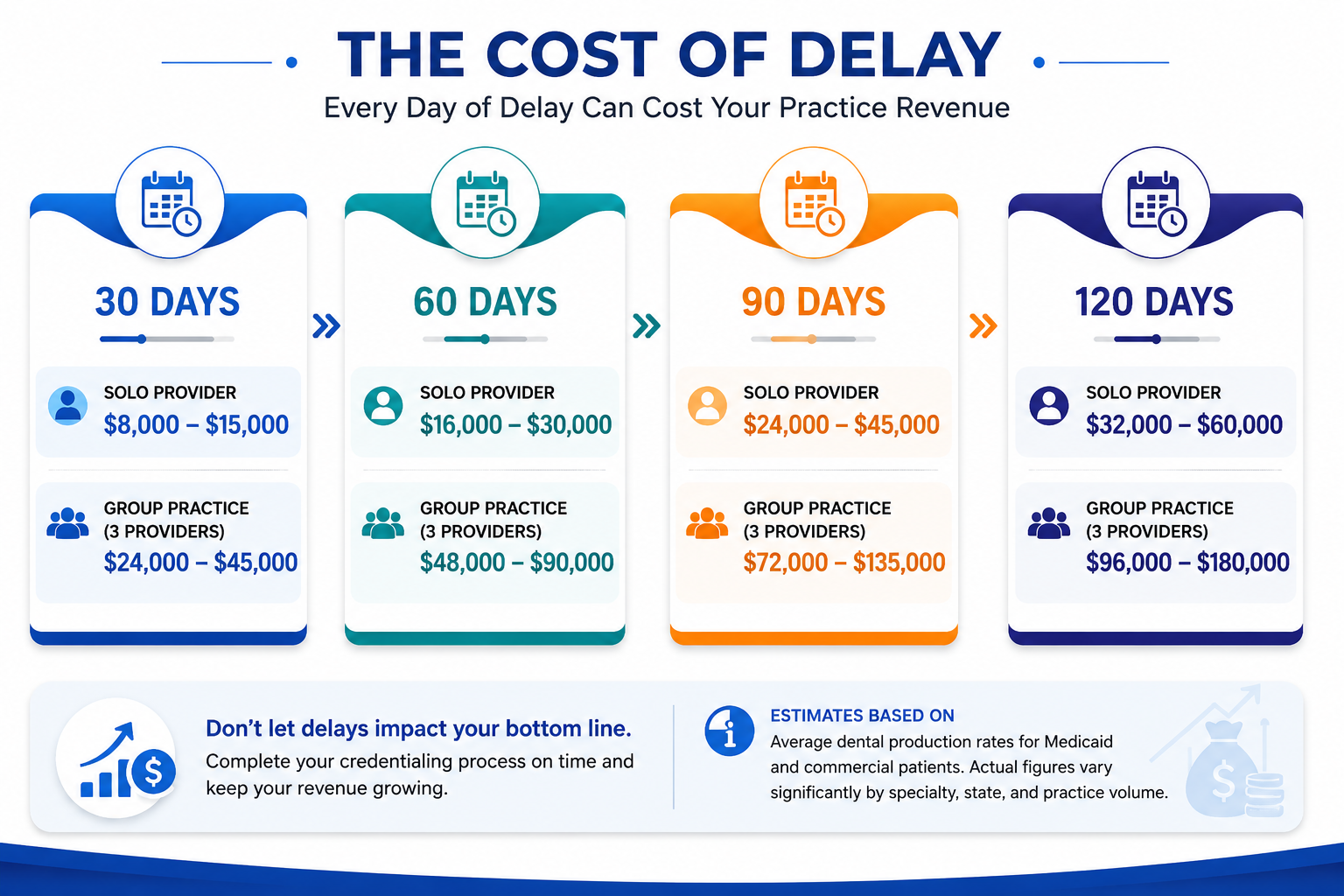
The Real Financial Cost of DentaQuest Credentialing Delays and What Your Practice Stands to Lose
Revenue Impact of DentaQuest Credentialing Delays
Understanding Your Rights as a DentaQuest Credentialing Applicant
Provider Rights During DentaQuest Credentialing
| Right | What It Means in Practice |
|---|---|
| Right to be informed of application status | You can request a credentialing status update at any time during initial credentialing or re-credentialing. |
| Right to a fair, non-discriminatory review | DentaQuest cannot make credentialing or recredentialing decisions based on race, ethnicity, gender, age, disability, sexual orientation, genetic information, economic status, or the types of patients you serve. |
| Right to appeal a denial or restriction | If the Credentialing Committee recommends denial or restricted participation, you are offered the opportunity to appeal. |
| Right to submit a written appeal within 30 days | Your appeal must be received within 30 days of DentaQuest's written notice of the committee's recommendation. |
| Right to state-level appeal | After completing DentaQuest's internal appeal process, you may escalate to the relevant state agency (e.g., DMAS in Virginia). |
| Right to notification of primary source discrepancies | If any information received from primary sources differs from what you submitted, you will be notified. |
| Right to correct inaccuracies | You may submit documentation to correct identified discrepancies in your credentialing file. |
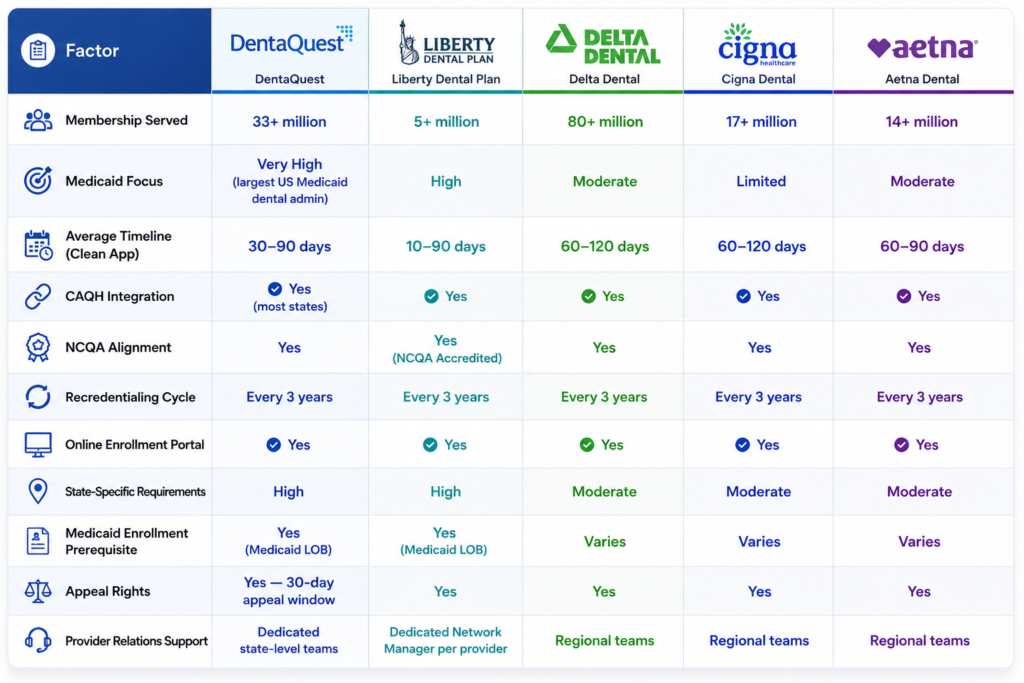
DentaQuest vs. Other Major Dental Payers
Credentialing Comparison: DentaQuest vs. Major Dental Payers