
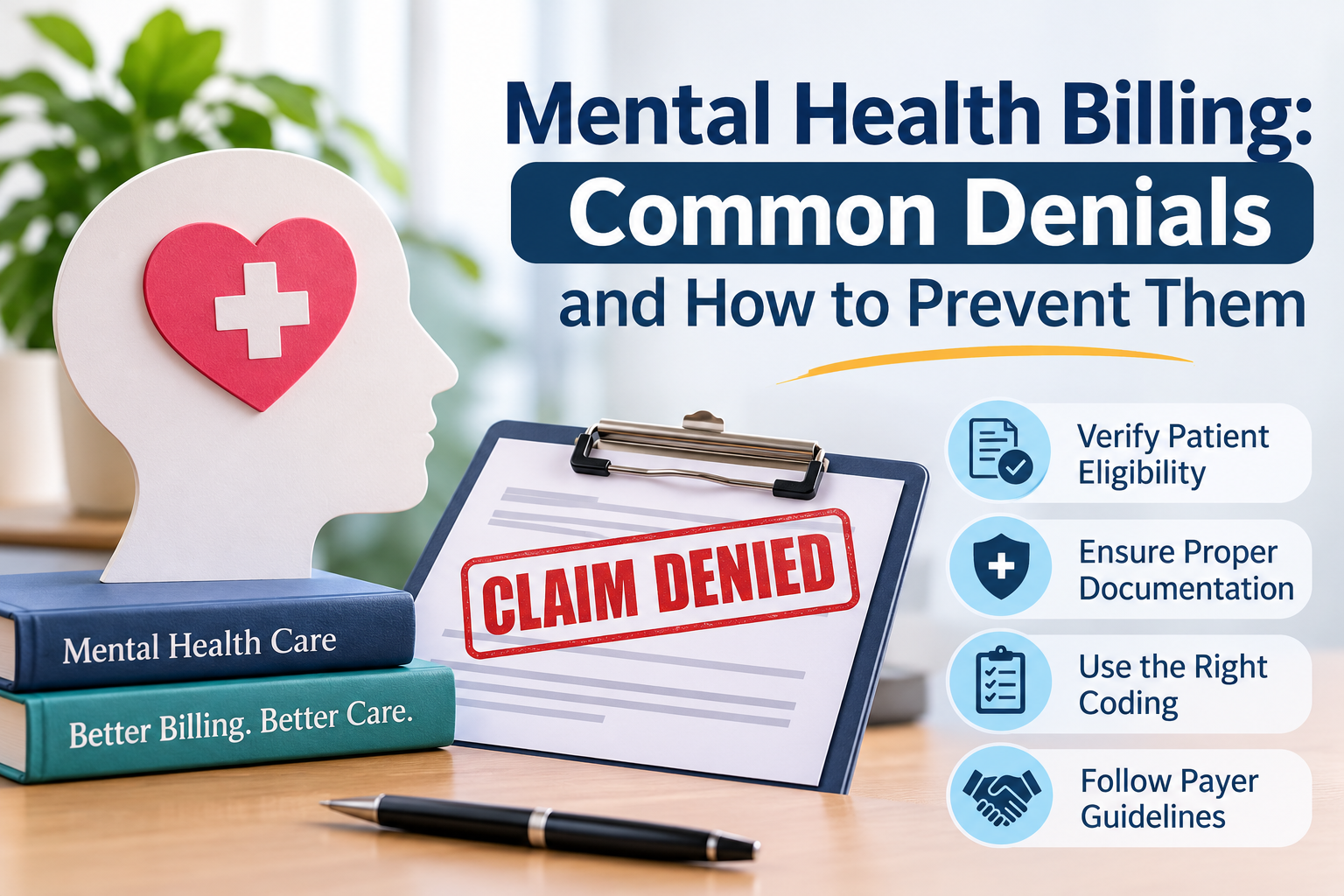
Mental health practices spend their days helping people. Then the claims come back denied. A session was coded for the wrong length of time, an authorization ran out, or a note did not explain why treatment was needed. Each denial means more work for your staff and a longer wait for payment.
This guide covers how mental health billing works, the most common reasons claims are denied, and the steps that prevent them. If you would rather hand the work to a team that does this every day, our behavioral health billing services support therapists, psychiatrists, and counseling practices.
Quick Answer
Mental health billing is the process of coding therapy and psychiatric visits, sending claims to insurance, and collecting payment. Most denials come from a short list of causes: session time that does not match the code, missing or weak documentation, authorization problems, eligibility errors, and providers who are not enrolled with the payer. Checking these before a claim goes out prevents most of them.
What Is Mental Health Billing?
Mental health billing covers the full process of getting paid for therapy, psychiatric evaluations, and medication management. It includes:
- Verifying insurance and behavioral health benefits
- Checking whether authorization is needed
- Documenting each session
- Coding the visit with the right diagnosis and procedure codes
- Submitting a clean claim
- Posting payments and following up on denials
- Billing the patient for copays, coinsurance, or deductibles
It is different from billing for many other specialties because most services are based on time, and most payers expect notes that show why treatment is medically necessary.
How Are Psychotherapy Sessions Coded?
Psychotherapy codes are based on how long the session lasts. Here are the most common ones.
Code | What it describes | Time range |
|---|---|---|
90791 | Psychiatric diagnostic evaluation, no medical services | Based on the evaluation |
90792 | Psychiatric diagnostic evaluation, with medical services | Based on the evaluation |
90832 | Psychotherapy, about 30 minutes | 16 to 37 minutes |
90834 | Psychotherapy, about 45 minutes | 38 to 52 minutes |
90837 | Psychotherapy, about 60 minutes | 53 minutes or more |
90846 | Family psychotherapy without the patient | Per payer and documentation |
90847 | Family psychotherapy with the patient | Per payer and documentation |
90853 | Group psychotherapy | Per session |
The session length in the note must match the code billed. A 40-minute session belongs with 90834, not 90837, even if the provider thinks of it as a one-hour appointment slot.
Prescribers such as psychiatrists, psychiatric nurse practitioners, and physician assistants may bill an evaluation and management (E/M) visit along with a psychotherapy add-on code, such as 90833, 90836, or 90838, when both services happen in the same visit. Payers generally expect the add-on codes in this case, so check each payer’s rules before submitting.
Why Do Mental Health Claims Get Denied?
Here are the most common reasons, and how to prevent each one.
Denial reason | Why it happens | How to prevent it |
|---|---|---|
Time and code mismatch | The note shows 40 minutes, but the claim says 60 | Record start and stop times, and code from the note |
Medical necessity | The notes do not show symptoms, goals, or progress | Document the diagnosis, treatment plan, and response to treatment |
Authorization missing or expired | The payer required approval, or the approved visits ran out | Track authorization dates and visit counts for each patient |
Eligibility errors | Coverage ended, changed, or was entered incorrectly | Verify benefits before the first visit and at regular intervals |
Wrong payer | Behavioral health is managed by a separate company | Confirm which payer handles mental health claims |
Provider not credentialed | The clinician is not enrolled with the payer | Complete credentialing before seeing insured patients |
Diagnosis problems | The diagnosis is missing, vague, or does not support the service | Use the most specific diagnosis the chart supports |
Visit limits reached | The plan caps the number of sessions | Check benefit limits and tell patients early |
Late filing | The claim went out after the payer’s deadline | Submit promptly and review aging claims often |
Telehealth coding errors | The place of service or modifier does not match the payer’s rules | Confirm each payer’s current telehealth policy |
Why Does Session Time Matter So Much?
Because psychotherapy codes are time-based, a mismatch between the note and the claim is one of the easiest ways to get a denial. It can also draw closer review from payers.
The fix is simple:
- Record the actual start and stop times, or total time, in every note
- Code the visit based on the time documented
- Do not round up to a longer code
- Make sure the note shows therapy took place, not only that the appointment was scheduled for a certain length
Some payers review claims for 60-minute sessions more closely than shorter ones, so clear time documentation is especially helpful for 90837.
What Should a Mental Health Progress Note Include?
Strong notes protect your claims and support patient care. For most payers, notes should show:
- The date and the session length
- The patient’s presenting concerns and symptoms
- The diagnosis the session addresses
- What was done in the session, such as the type of therapy and interventions
- The patient’s response and progress toward goals
- The plan for the next steps
The treatment plan should be current and connected to the diagnosis. If a payer asks for records, notes that clearly show why treatment is needed make approval much easier.
Do Mental Health Services Need Prior Authorization?
Sometimes. Requirements vary by payer and plan. Some plans require approval for certain services, such as psychological testing or higher levels of care. Others review treatment after a set number of sessions.
To stay ahead of it:
- Ask about authorization rules when you verify benefits
- Record the authorization number, approved dates, and number of visits
- Set reminders before approvals run out
- Start renewal requests early, since reviews can take time
What Is a Behavioral Health Carve-Out?
Some insurance plans send mental health claims to a separate company. The patient’s card may show a medical plan, while a different payer handles therapy and psychiatric care. If the claim goes to the wrong payer, it will be denied or rejected.
When you verify coverage, ask who manages behavioral health benefits and where claims should be sent. Write it down in the patient’s file so the next claim goes to the right place.
What Should Practices Know About Telehealth Mental Health Billing?
Many practices offer therapy through telehealth, and billing rules vary. Many payers use place of service 02 or 10 and modifier 95 for telehealth, but policies differ and have changed over time. Check each payer’s current rules before billing.
If your clinicians treat patients in more than one state, they also need the right licenses and payer enrollment for each state. Our guide to multi-state licensure and credentialing for telehealth explains how those pieces fit together.
How Can Mental Health Practices Reduce Claim Denials?
A short checklist can prevent most problems:
- Verify benefits before the first visit. Include copay, deductible, visit limits, and authorization rules.
- Confirm the right payer. Ask about behavioral health carve-outs.
- Complete credentialing first. Do not schedule insured patients before the effective date.
- Record time accurately. Match the code to the documented session length.
- Write notes that show medical necessity. Link the diagnosis, treatment plan, and progress.
- Track authorizations. Watch dates and remaining visits.
- Review claims before submitting. Fixing a mistake early is faster than appealing.
- Work denials promptly. Review the reason, correct the claim, and appeal within the payer’s deadline.
How Do You Appeal a Denied Mental Health Claim?
Start by reading the denial reason carefully. Then:
- Find out whether the issue is a simple fix, such as a missing modifier, or needs a formal appeal
- Gather supporting records, such as the progress note and treatment plan
- Write a clear appeal that explains why the service was needed and correctly billed
- Submit it before the payer’s appeal deadline
- Track the result, and note any patterns to fix at the source
Appeal deadlines differ by payer, so check the denial notice and your contract.
Should a Mental Health Practice Outsource Billing?
If your clinicians or office staff spend hours on insurance instead of patients, outsourcing may help. A billing partner can handle eligibility checks, coding, claim submission, authorization tracking, denial follow-up, and reporting.
East Billing supports providers nationwide with medical billing services and credentialing support, so your practice can stay focused on care.
Want a clearer picture of where claims are getting stuck? Request a behavioral health billing review and we will look at your claims and denial history with you.
Frequently Asked Questions
What is mental health billing? Mental health billing is the process of coding therapy and psychiatric visits, submitting claims to insurance, and collecting payment. It includes verifying benefits, documenting sessions, and following up on denials.
What is the difference between 90834 and 90837? Both are psychotherapy codes based on time. 90834 is used for sessions of 38 to 52 minutes, and 90837 is used for sessions of 53 minutes or more. The documented session time should match the code billed.
Why are mental health claims denied? Common reasons include session time that does not match the code, notes that do not show medical necessity, expired or missing authorization, eligibility errors, wrong payer, and providers who are not enrolled with the plan.
Do therapists need to be credentialed with insurance? To bill a payer as an in-network provider, yes. A provider must be credentialed and enrolled with that payer first. Rules for supervised clinicians vary, so check each payer’s policy.
What is a behavioral health carve-out? It is when an insurance plan sends mental health claims to a separate company instead of the main health plan. Confirm which payer manages mental health benefits for each patient.
Can psychiatrists bill an E/M visit and psychotherapy on the same day? Yes, when both services are provided and documented. Payers generally expect an E/M code with a psychotherapy add-on code, such as 90833, 90836, or 90838. Confirm the specific rules for each payer.
How long do I have to appeal a denied mental health claim? The deadline depends on the payer and the plan. Check the denial notice and your provider contract, and act quickly so you do not lose the right to appeal.