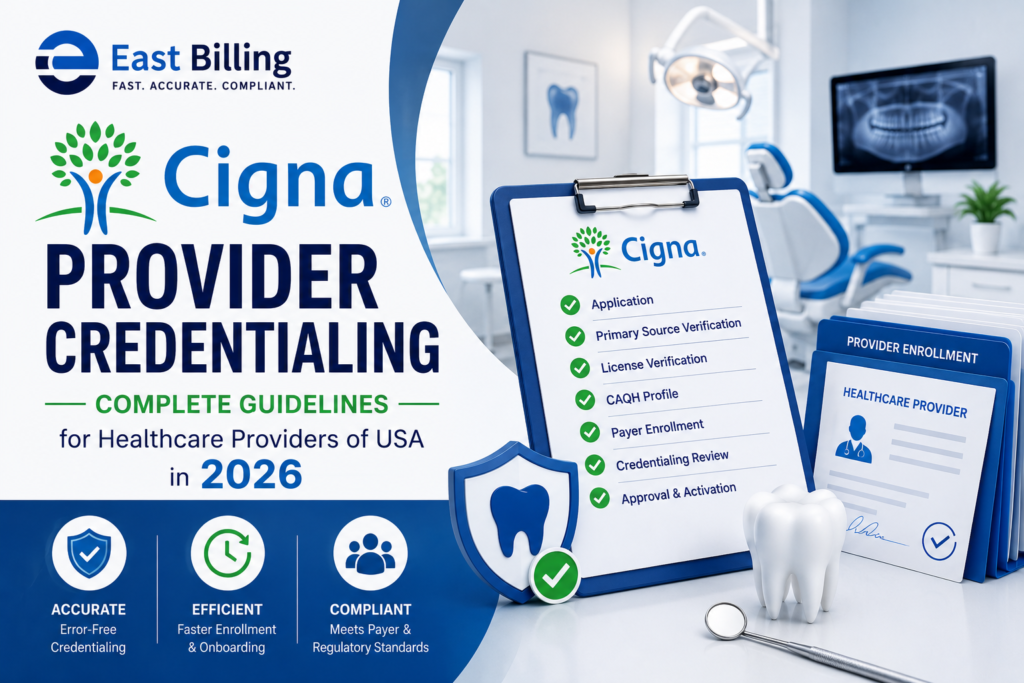
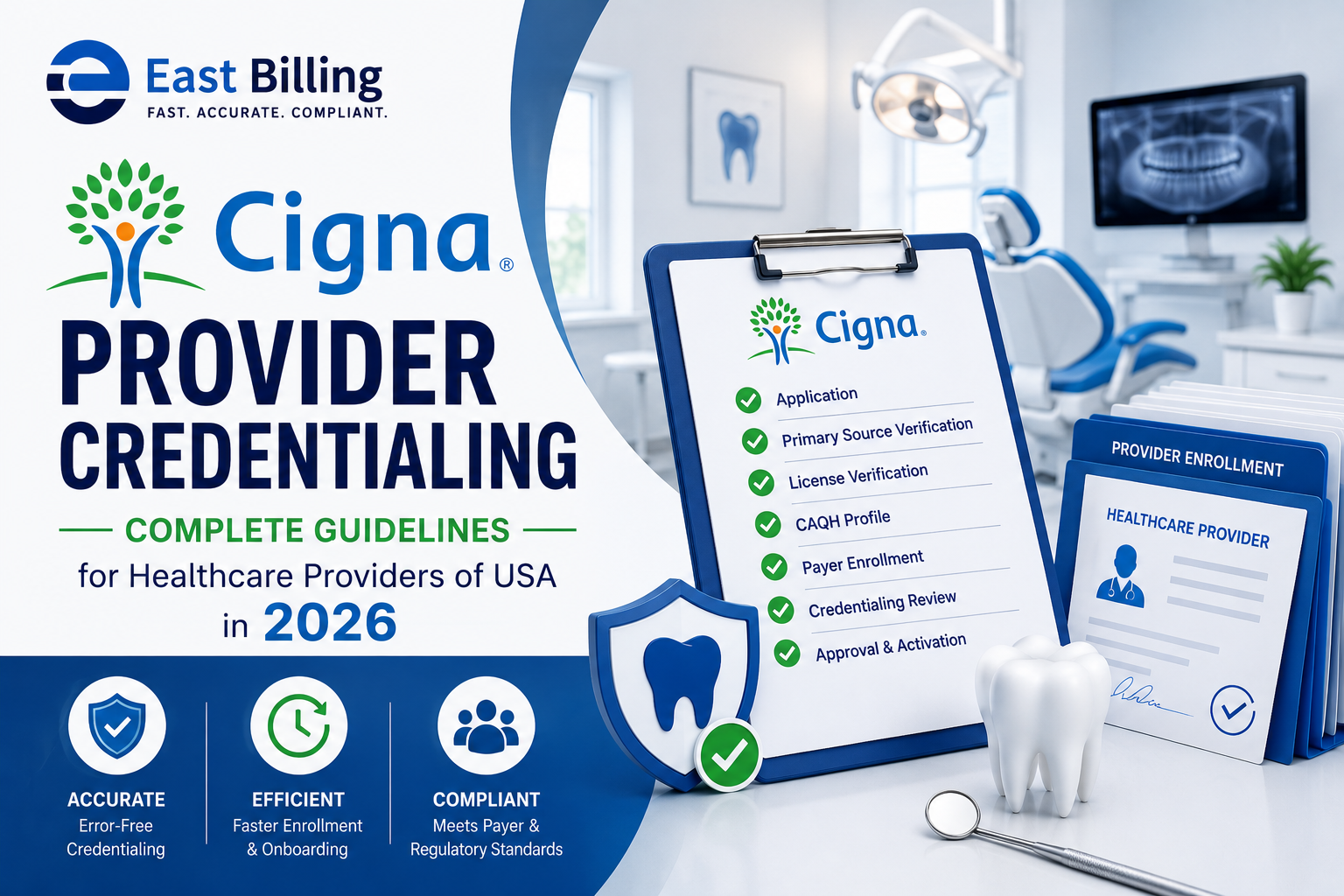
What Is Cigna Provider Credentialing and Why Every Healthcare Provider Must Take It Seriously
If you are a healthcare provider in the USA and you want to get paid for seeing Cigna members in different states, credentialing is not optional. It is the first gate you have to pass through, and if you skip it or get it wrong, every claim you submit could be denied, or delayed by Cigna insurance company.
So what exactly is Cigna provider credentialing? Simply put, it is the process Cigna uses to verify that a healthcare provider in the USA, whether a physician, nurse practitioner, therapist, or specialist, is qualified, licensed, and safe to treat patients within their network. Cigna insurance has an expert team that checks your education, training, board certifications, malpractice history, state licenses, and more before approving you to see their members as an in-network provider.
At East Billing, we see providers lose thousands of dollars every month simply because their credentialing is delayed, incomplete, or incorrectly submitted. Our experts have written this guide to help you understand the entire Cigna credentialing process, what it involves, what can go wrong, what the law says, and how our experts protect your practice every step of the way.
The Complete Cigna Provider Credentialing Checklist You Should Have Before Applying
One of the most common reasons Cigna credentialing applications get delayed is simple, when you apply without having all the required documents ready. Cigna’s credentialing team will not wait for you to gather missing items. They will either send your application back or put it on hold, and every day of delay is a day you cannot bill as an in-network provider. It is necessary before you even begin your application, make sure every item on this checklist is ready and up to date.
Cigna Provider Credentialing — Document Requirements Table
| Document / Requirement | Details Required | Notes |
|---|---|---|
| Valid State Medical License | Current, active, no restrictions | Must match state(s) where you practice |
| DEA Certificate | Current registration number | Required if prescribing controlled substances |
| Board Certification | Primary specialty board certificate | Must be active or eligible |
| NPI Number (Type 1 & 2) | Individual and Group NPI | Both may be required |
| CAQH Profile | Fully completed and attested | Must be updated within 120 days |
| Malpractice Insurance | Current policy with coverage amounts | Minimum coverage varies by specialty |
| Medical School Diploma | Copy of degree | All degrees earned |
| Residency / Fellowship Completion | Certificates or letters | From training program directors |
| Work History (10 Years) | All employers, gaps explained | No unexplained gaps allowed |
| Hospital Affiliations | Active privileges at one or more hospitals | Some specialties require this |
| Government Sanction Check | OIG and SAM exclusion list clearance | Cigna checks this independently |
| Medicare / Medicaid Enrollment | PECOS enrollment confirmation | Required for participation |
| Tax ID / W-9 Form | Current EIN for your practice | Must match your billing setup |
| Collaborative Agreement | Required for NPs and PAs in some states | State-specific requirement |
Why Cigna Provider Credentialing Gets Denied and What You Can Do to Fix It Fast
As a healthcare professional you know that denial, it is one word, but for a provider who has been waiting 90 days to get into the Cigna network, it is a big problem. The frustrating part is that most denials are preventable. They happen not because the provider is unqualified, but because the application had avoidable errors or missing information. Here are the most common reasons Cigna can deny your practice credentialing application, and what you can do immediately if it happens to you.
Incomplete or Expired Documents: If even one document is missing, expired, or inconsistent with what is in your CAQH profile, Cigna will flag your application. A license that expired two months ago, a malpractice policy that lapsed, or a DEA certificate you forgot to renew can all trigger a denial.
What to do: You need to audit every document before you apply. Set calendar reminders for every renewal date, license, DEA, malpractice, and board certification. At East Billing, we manage renewal tracking for our clients so nothing slips through the cracks.
Malpractice History or Licensing Sanctions Cigna runs a thorough background check. If you have had a malpractice settlement, a state board investigation, or a Medicare or Medicaid sanction, Cigna needs full disclosure. Failing to disclose, even unintentionally, is treated as a red flag and can lead to denial or termination.
What to do: Be proactive. Disclose everything and provide documentation that explains the circumstances and outcomes. A single incident does not automatically mean disqualification, but hiding it does.
Gaps in Work History Cigna wants a complete 10-year work history with no unexplained gaps. If you took time off for family reasons, illness, or further training, that needs to be explained in writing.
What to do: You need to write a clear, brief explanation letter for any gap exceeding 30 days. Attach supporting documentation if possible.
Wrong or Mismatched Information: If your name spelled differently, a different NPI than what is on file, or a tax ID that does not match your billing records, these small inconsistencies can create big delays or outright denials.
What to do: It is your responsibility to cross-check every piece of information against your CAQH profile, NPI registry, and IRS records before submitting.
Network Closure: In the USA sometimes Cigna is simply not accepting new providers in a specific specialty or geographic area. This is not a reflection on you, but it is a real barrier.
What to do: It is your responsibility to contact Cigna’s provider relations team directly, or work with a credentialing specialist like East Billing who can identify open panels and position your application for the next available opening.
The Biggest Cigna Credentialing Mistakes Providers Make and How You Can Avoid
If your healthcare practice is in the credentialing process with Cigna in the USA, you already know it can feel overwhelming. If you are going through it for the first time, the sheer volume of paperwork and follow-up required can catch you off guard. Either way, certain mistakes show up again and again, and they cost providers time, money, and peace of mind.
At East Billing, we have helped hundreds of providers through the Cigna credentialing process, and these are the mistakes we see most frequently.
Applying Without a Fully Attested CAQH Profile: It is our experience that providers often submit their Cigna application before their CAQH profile is 100% complete and freshly attested. Since Cigna pulls directly from CAQH, an incomplete profile means an incomplete application.
Not Following Up After Submission: It is clear that after submitting your application is not the finish line. Cigna may send additional document requests or ask for further clarifications from your side.
Using the Wrong NPI: You know that individual providers have a Type 1 NPI. Group practices have a Type 2 NPI. Using the wrong one, or failing to include both is a surprisingly common mistake that causes immediate processing delays.
Forgetting to Enroll in PECOS: If you plan to see Medicare or Medicaid patients through Cigna, your PECOS enrollment must be active and current. Many providers overlook this until it becomes a billing problem.
Assuming Approval Means You Can Bill Immediately: Even after receiving your approval letter, there is a processing period before you are fully active in Cigna’s system. Billing before your effective date results in claim denials and can trigger audits.
Not Tracking the Credentialing Timeline: The process takes 60 to 120 days on average. Providers who do not track their timeline miss opportunities to follow up at critical checkpoints and often end up waiting far longer than necessary.
The East Billing Solution: Our dedicated credentialing team members accurately manage the process, from CAQH profile setup to application submission, follow-up, and final confirmation..
How Long Does Cigna Credentialing Really Take and What Is Causing All These Frustrating Delays
According to our experience we know that Cigna credentialing is not fast. The standard timeline runs anywhere from 60 to 120 days, and in some cases it can stretch even longer. For a provider who needs to start seeing patients and generating revenue, that timeline can feel unbearable.But understanding what causes delays helps you take control of the process.
Primary Reason for Delays — Missing or Incomplete Documentation: Our experience shows that this is the number one cause. When Cigna sends a request for additional information and you do not respond quickly, the application clock essentially resets. Speed of response is everything.
Secondary Reason — CAQH Profile Not Attested: CAQH attestation must be renewed every 120 days. If your attestation lapses during the credentialing process, Cigna cannot access your data and your application stalls.
Third Reason — High Application Volume: Cigna processes thousands of credentialing applications at any given time. If you applied during a period of high volume, such as the beginning of the year when many practices renew contracts, expect longer wait times.
Fourth Reason — Primary Source Verification Delays: Cigna does not just take your word for your credentials. They verify everything directly with the issuing institution, medical schools, residency programs, state licensing boards, and hospitals. If any of those institutions are slow to respond, it slows down your entire application.
Federal and State Laws That Govern Cigna Provider Credentialing and What You Must Know to Stay Compliant
Credentialing is not just a Cigna policy, it is governed by a complex web of federal and state laws. Understanding these laws protects your medical practice from legal exposure and helps you understand your rights as a provider in the credentialing process.
Key Laws and Regulations Governing Cigna Provider Credentialing
| Law / Regulation | What It Covers | Impact on Credentialing |
|---|---|---|
| National Practitioner Data Bank (NPDB) | Tracks malpractice payments, licensure actions, exclusions | Cigna queries NPDB during credentialing; unresolved reports can block approval |
| Health Care Quality Improvement Act (HCQIA) | Provides legal immunity to credentialing bodies acting in good faith | Cigna is protected when making credentialing decisions in good faith |
| OIG Exclusion List (42 U.S.C. § 1320a-7) | Providers excluded from federal programs | Being on the OIG list results in automatic Cigna disqualification |
| HIPAA (45 CFR Parts 160 & 164) | Privacy and security of provider information | Cigna must protect your credentialing data under HIPAA |
| ADA (Americans with Disabilities Act) | Anti-discrimination provisions | Cannot be denied solely due to a disability unrelated to competency |
| State Medical Practice Acts | Licensing requirements by state | All state licenses must comply with state-specific laws |
| State Network Adequacy Laws | Minimum provider network requirements | Cigna must maintain adequate networks per state mandate |
| CMS Conditions of Participation | Federal standards for Medicare/Medicaid | PECOS enrollment and OIG clearance are federal requirements |
| ERISA (29 U.S.C. § 1001 et seq.) | Governs employer-sponsored health plans | Affects how Cigna administers credentialing for self-funded plans |
How NCQA and URAC Standards Directly Shape the Way Cigna Credentials Healthcare Providers
When you submit a credentialing application to Cigna, you might wonder, who is checking the people doing the checking? The answer is NCQA and URAC, two independent accreditation organizations that set the national standards for how health plans like Cigna must conduct credentialing.
As a healthcare professional you need to understand these standards gives you a major advantage because it tells you exactly what Cigna is required to do, and what they cannot cut corners on.
NCQA vs URAC Credentialing Standards Comparison
| Standard Area | NCQA Requirements | URAC Requirements |
|---|---|---|
| Credentialing Cycle | Re-credential every 36 months | Re-credential every 36 months |
| Primary Source Verification | Required for all core credentials | Required; specific sources defined |
| CAQH Integration | Accepted as primary source | Accepted with attestation |
| Sanction Monitoring | Ongoing OIG and SAM checks | Monthly sanction monitoring required |
| Credentialing Committee | Required for all decisions | Required; documented decisions |
| Appeals Process | Providers must have formal appeal rights | Formal appeals process required |
| Delegated Credentialing | Allowed with oversight audits | Allowed with compliance audits |
| Malpractice History Review | Must review all incidents | Must review and document findings |
| Practitioner Rights | Must be informed of rights | Must provide rights information |
The Real Benefits of Getting Credentialed with Cigna That Most Providers Never Talk About
Our experience shows that mostly conversations about Cigna credentialing focus on the problems, and there are real problems. But once you are credentialed and active in the Cigna network, the benefits are substantial and ongoing. This is why, despite the challenges, the process is absolutely worth pursuing.
Cigna Credentialing Benefits Breakdown
| Benefit | What It Means for Your Practice |
|---|---|
| Access to Millions of Patients | Cigna covers over 16 million medical customers; being in-network opens your practice to all of them |
| Higher Reimbursement Rates | In-network rates are negotiated and typically higher than out-of-network payments |
| Increased Patient Volume | Patients actively search for in-network providers; being listed drives new patient inquiries |
| Enhanced Practice Credibility | Cigna credentialing signals professional legitimacy to patients and referral sources |
| Listing in Cigna's Provider Directory | Free exposure to Cigna members searching for providers in your specialty and area |
| Reduced Patient Financial Burden | Lower co-pays for patients = higher likelihood they will follow through with appointments |
| Better Referral Relationships | Other in-network providers are more likely to refer patients to you |
| Streamlined Claims Processing | In-network claims are processed faster and with fewer denials than out-of-network |
| Access to Cigna's Care Programs | Participation in value-based care and care management programs |
| Business Growth Foundation | Credentialing with one major payer opens the door to credentialing with others |
How Cigna Provider Credentialing Protects Your Practice Your Patients and Your Long Term Revenue
Credentialing is often viewed purely as an administrative hurdle. But there is a much bigger picture, one that touches your legal protection, your clinical reputation, and your financial security for years to come.
It Protects Your Patients At its core, credentialing exists to protect patients. When the Cigna team will verify that you are licensed, trained, and in good standing, they are telling their members that you are a safe and qualified provider. This process filters out providers who should not be practicing, which ultimately protects everyone in the healthcare system.
It Protects Your Practice Legally: If a malpractice claim is ever filed against you, one of the first things an attorney will look at is whether you were properly credentialed. Maintaining active, up-to-date credentialing with all relevant payers is a mark of professional compliance that works in your favor legally.
It Protects Your Revenue: This is where it gets very practical. If you are seeing Cigna patients without being in-network, you are likely not billing at the correct rate, and you may be creating liability for yourself around surprise billing laws. Being properly credentialed means every claim is on solid legal and contractual ground.
It Builds Long-Term Stability: It is our experience that providers who are credentialed with multiple major payers, starting with Cigna build a diversified revenue base that is more resilient to payer policy changes. When one payer reduces rates or changes coverage, in-network providers have options. Out-of-network providers are always vulnerable.
Why Independent and Small Practice Providers Should Stop Delaying Their Cigna Credentialing
If you are running a solo practice or a small group in the USA, you have probably told yourself at some point that credentialing can wait. Maybe you are managing it yourself between patient appointments. Maybe you started the application and got overwhelmed. Maybe you think your practice is too small to make it worth the effort. All of those thoughts are costing you money every single day. Here is the truth about small and independent practices and Cigna credentialing:
You Need the Volume More Than Large Practices Do: Large hospital systems in the USA have guaranteed patient flow from multiple referral sources. Independent providers rely heavily on in-network listings to attract new patients. Cigna’s provider directory is one of the most powerful free marketing tools available to your healthcare practice, but only if you are in the network.
The Credentialing Process Does Not Get Easier by Waiting: Your CAQH profile ages. Your documents expire. The credentialing landscape gets more complex every year. The longer you wait, the more you will need to update and gather before you can even start. Start now.
Your Competitors Are Already Credentialed: When a Cigna member in your area searches for a provider in your specialty, they see a list of in-network providers. If you are not on that list, they go to someone else.
East Billing Specializes in Independent and Small Practice Credentialing: We understand that your small practice does not have a dedicated credentialing department. That is exactly why we exist. Our team members handle every aspect of the process so that you can focus on what you do best, taking care of patients.
Everything You Need to Know About Cigna Re-Credentialing Before Your Deadline Hits
Getting credentialed with Cigna is a major achievement. But it is not a permanent one. Cigna in compliance with NCQA standards, requires all providers to go through re-credentialing every 36 months. If you miss your re-credentialing deadline, you risk being removed from the Cigna network, and that means lost revenue until you are reinstated.
When Does Re-Credentialing Start? Cigna typically initiates the re-credentialing process 120 to 180 days before your credentialing period expires. You should receive a notification, but do not count on it arriving on time or at all. Track your credentialing expiration date yourself and start preparing at least 6 months in advance.
What Does Re-Credentialing Involve? Re-credentialing is similar to initial credentialing but focused on verifying that nothing has changed negatively since your last review. Cigna will check:
- Any new malpractice claims or settlements
- Any changes to your state medical license
- Any OIG or SAM exclusions
- Updated hospital privileges
- Current malpractice insurance coverage
- Any board certification changes
Ready to Get Credentialed with Cigna? East Billing Is Here to Help.
Cigna provider credentialing is one of the most important processes for the life of your medical healthcare practice, and one of the most misunderstood. The problems are real, the laws are complex, and the stakes are high. But the benefits, access to millions of patients, faster reimbursements, legal protection, and long-term revenue stability, make every step of the process worth it.
At East Billing, we specialize in making credentialing simple, fast, and stress-free for healthcare providers of every size and specialty. Whether you are starting your first credentialing application, recovering from a denial, or approaching your re-credentialing deadline, our team is ready to take the burden off your plate.