What Is Healthplex Provider Credentialing and Why Every Dental Provider in the New York Metro Area Cannot Afford to Ignore It
If you are a dentist practicing in New York, New Jersey, or Connecticut or anywhere Healthplex operates, and you want access to one of the most established dental networks in the region, getting credentialed with Healthplex is important for your long term success. It is the gateway to your in-network participation, your reimbursement rights, and your ability to grow a thriving dental practice in one of the most competitive markets in the country.
So what exactly is Healthplex provider credentialing? Healthplex, Inc. is a dental benefits administrator headquartered in New York that manages dental plans for major health systems, employer groups, municipal governments, and insurance carriers, including UnitedHealthcare, VNS Health, NYC Health + Hospitals, Nassau County employees, and many more. Healthplex administers PPO plans, managed care dental plans, Medicare dental benefits, and Medicaid dental programs across its service territory.
What makes Healthplex particularly significant in the credentialing world is this, Healthplex is fully certified as a Credentials Verification Organization (CVO) by the National Committee for Quality Assurance (NCQA) in all ten out of ten credentialing verification services. That is the highest possible NCQA credentialing certification a dental organization can achieve. It means Healthplex’s credentialing process is not informal or flexible. It is rigorous, standards-driven, and conducted by certified credentialing specialists who hold every applicant to the same demanding benchmark.
At East Billing, we specialize in helping dental providers understand the Healthplex credentialing process from start to finish. We know exactly what Healthplex requires, how their process works, and what it takes to get applications approved quickly and correctly. If you are ready to build your practice in the Healthplex network, this guide is your complete roadmap.
The Complete Healthplex Provider Credentialing Checklist You Should Have Ready Before Submitting an Application
Healthplex’s NCQA certification means their credentialing team verifies every credential through primary sources, they do not simply take your word for anything. Every document you submit will be checked against the original issuing institution. Every license will be verified with the state dental board. Every malpractice history disclosure will be investigated. Every gap in your work history will need an explanation.
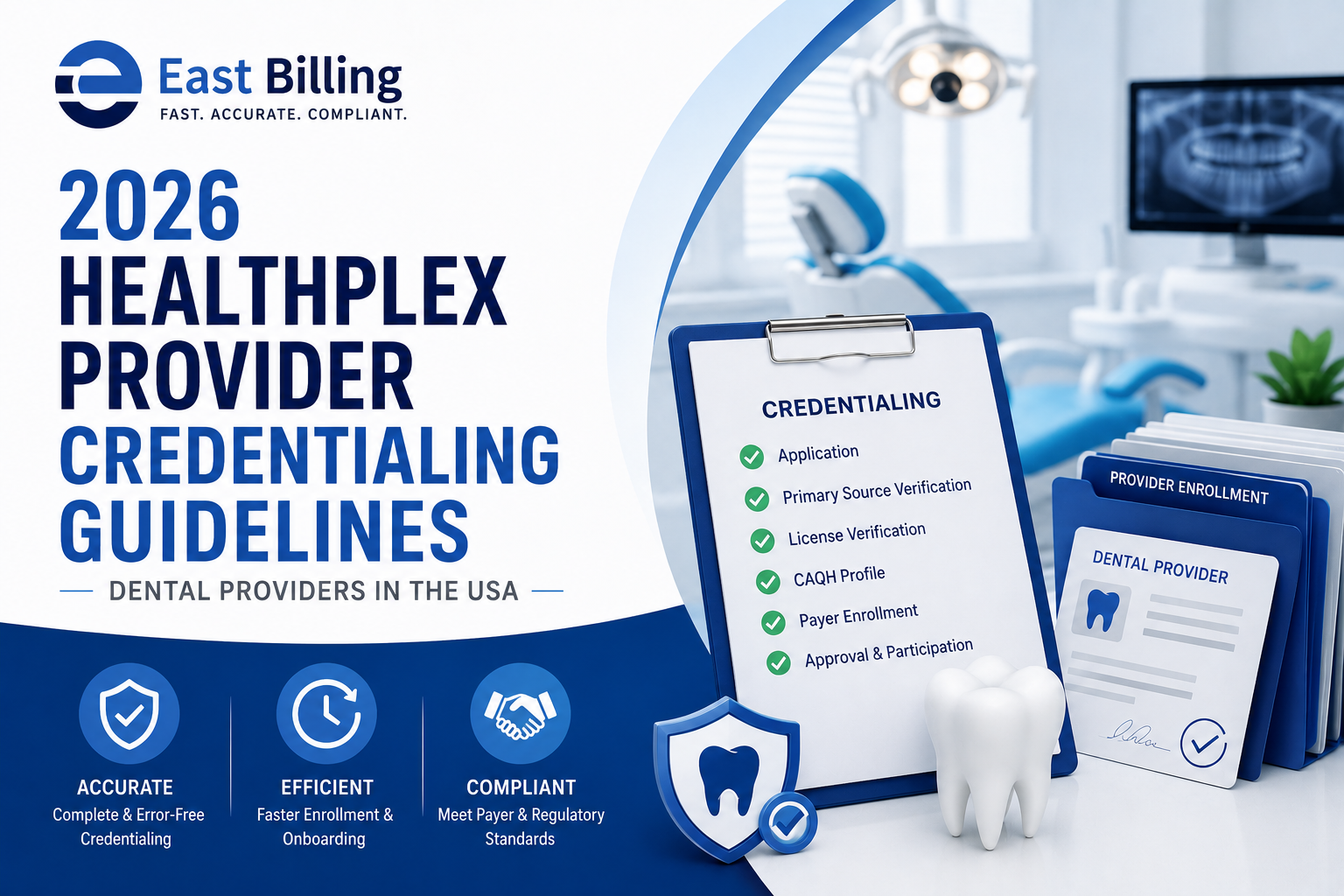
Healthplex Provider Credentialing
| Document / Requirement | Details Required | Important Notes |
|---|---|---|
| Active State Dental License | Current, unrestricted license in NY, NJ, or CT (or applicable state) | Must be in good standing with no pending actions |
| DEA Certificate | Active federal registration number and expiration date | Required if prescribing any controlled substances |
| Individual NPI (Type 1) | 10-digit individual provider NPI number | Must be registered in NPPES registry |
| Group NPI (Type 2) | Group or practice NPI number | Required for group practice enrollment |
| Dental School Diploma | Degree from CODA-accredited dental school | Healthplex verifies directly with the institution |
| Specialty Training Certificates | Residency, GPR, specialty program completion letters | Required for all specialists applying under specialty codes |
| Board Certification | Active certification with board name and number | Required for specialists; Healthplex verifies with certifying body |
| Malpractice Insurance Certificate | Active policy with carrier name, policy number, limits | Minimum $1M per occurrence / $3M aggregate typically required |
| Professional Liability History | All malpractice claims, settlements, pending matters | Full disclosure required; omissions are grounds for termination |
| Work History (5–10 Years) | All employers and practice locations; all gaps explained | Written explanation required for any gap over 30 days |
| Hospital or Facility Privileges | Current admitting or surgical privileges if applicable | Particularly important for oral surgeons |
| Government Program Status | Medicare and/or Medicaid enrollment if applicable | PECOS and/or state Medicaid enrollment confirmation needed |
| OIG and SAM Exclusion Clearance | Confirmation of non-exclusion from federal programs | Healthplex runs independent exclusion checks |
| Government Sanction Disclosure | Full disclosure of any sanctions, investigations, or actions | Non-disclosure is immediate grounds for denial |
| W-9 / Tax Identification Number | Current EIN for your practice | Must match your billing information exactly |
| Practice Location Information | All office addresses, phone numbers, and hours | Healthplex credentialing is location-specific |
| Site Visit Readiness | Office equipped, staffed, and following sterilization protocols | Healthplex conducts site visits as part of network management |
Why Healthplex Provider Credentialing Gets Denied
A denial from Healthplex is never what any provider wants to face, especially after weeks of gathering documents and waiting for the process to move forward. But Healthplex denials happen, and when they do, they almost always trace back to a small number of very specific, preventable causes. You need to understand why denials happen and give you the power to prevent them before they occur, and to respond effectively if they do.
Incomplete or Inconsistent Application Data: Because Healthplex is NCQA-certified across all ten credentialing verification services, their verification team checks every detail against primary sources. A discrepancy between the name on your dental license and the name in your application, a different address than what is on file with your state board, or a mismatched NPI, any of these inconsistencies will trigger a flag and stop your application cold.
What to do: Before submitting, cross-reference every piece of information across your state dental board registration, your NPPES NPI profile, your malpractice policy, and your W-9. Every name, every address, every number must match precisely. At East Billing our specialist team conducts a full data consistency audit for every application we submit.
Undisclosed or Improperly Disclosed Malpractice History: Healthplex takes malpractice history disclosure very seriously. If you have had any malpractice claims, settlements, or pending actions, even ones from years ago, they must be fully disclosed. Healthplex will find them through independent verification, and discovering an omission is treated far more seriously than the original incident.
What to do: Disclose everything. Write a clear, factual explanation of each incident, what happened, how it was resolved, and what you have done since. Transparency gives Healthplex the information they need to make a fair decision. Omission gives them grounds for permanent disqualification.
License Restrictions or State Board Actions: Any current or historical restriction on your dental license, even a corrected or expired action, must be disclosed. Healthplex verifies directly with your state dental board and will discover any actions whether you disclose them or not.
What to do: Pull your full license history from your state dental board before applying. Know exactly what is on record so you can address it proactively in your application.
Network Capacity in Your Area or Specialty: Healthplex may have a closed or restricted panel in certain geographic areas or specialties at the time you apply. This is particularly relevant in dense urban areas like Manhattan or Brooklyn where Healthplex’s network is already robust in certain specialties.
What to do: Contact Healthplex’s provider relations team before investing time in a full application to confirm whether your specialty and location has an open panel. East Billing can also help you assess panel availability based on our working knowledge of Healthplex’s network status.
Site Visit Issues: If Healthplex conducts a site visit and finds that your office does not meet their standards for equipment, staffing, or infection control, they may delay or deny your credentialing until issues are corrected.
What to do: Prepare your office before you apply. Make sure your sterilization procedures are documented and followed, your equipment is maintained and current, and your staff is in place. Treat the site visit as a professional inspection — because that is exactly what it is.
If you receive a formal denial, request written documentation of the specific reason, gather your corrected materials, and submit a formal appeal within Healthplex’s specified timeframe — typically 30 to 60 days.
Healthplex Credentialing Mistakes Providers Make
Healthplex’s high credentialing standards are driven by their NCQA certification across all ten verification categories, which means there is very little room for error in the application process. The mistakes providers make are almost always the result of rushing, misunderstanding the process, or trying to manage everything without dedicated credentialing support. At East Billing, we have seen these mistakes happen repeatedly. Here is how to make sure none of them during your practice credentialing process..
Not Understanding That Healthplex Is a CVO, Not Just a Payer: Healthplex functions as a Credentials Verification Organization, meaning they are also providing credentialing services to other health plans and organizations beyond their own dental plans. This means their verification process is even more rigorous than a typical insurance company credentialing department. Providers who approach Healthplex credentialing the same way they approach a standard insurance application are often surprised by the level of detail required.
Failing to Prepare for the Site Visit: Unlike most national payers who rely purely on document verification, Healthplex physically visits your office as part of the network participation process. Providers who are not prepared for this, who have equipment that needs maintenance, sterilization documentation that is not current, or staffing that does not reflect what was listed on the application, is face delays and additional requirements before approval.
Applying Without Checking Panel Availability First: Healthplex’s network is particularly dense in the New York metropolitan area. In some zip codes and specialties, the panel may be at or near capacity. Applying without checking first wastes everyone’s time and can be discouraging for providers who do not understand why they were turned away despite having impeccable credentials.
Submitting Paper Applications Instead of Using Available Digital Tools: Healthplex has moved toward more digital credentialing and provider management tools, including the transition to UHCdental.com for eligible commercial plans. Providers who submit applications through outdated channels or fail to use the current system risk delays and miscommunication.
Not Tracking the Timeline After Submission: The credentialing process does not run itself. After submission, providers need to follow up regularly, respond promptly to any additional information requests, and confirm that their application is moving through the process as expected. Providers who submit and wait passively often find their applications stalled for no reason other than lack of follow-up.
Credentialing at the Practice Level But Not the Individual Provider Level: In a group dental practice, every individual provider must be credentialed separately with Healthplex, not just the practice entity. Bringing on a new associate or specialist? That individual needs their own credentialing application, their own verification process, and their own effective date before they can bill under the Healthplex network.
How Long Does Healthplex Credentialing Really Take and What Is Causing All These Frustrating Delays
Healthplex credentialing, when everything is submitted correctly and completely, typically takes between 60 and 90 days from the date of a complete application. However, because Healthplex conducts thorough primary source verification across all ten NCQA credentialing categories, there are multiple points in the process where delays can occur, and some of them are beyond your direct control. Below we have mentioned some reasons for credentialing process delay.
Primary Source Verification Timelines: Because Healthplex is NCQA-certified and verifies every credential through the original issuing institution, the speed of your application depends in part on how quickly those institutions respond. Dental schools, residency programs, specialty boards, and state licensing bodies all have their own processing timelines. Some respond within days. Others take several weeks. Healthplex cannot move forward until verification is received.
Incomplete Applications: We know that even a single missing document or a discrepancy that requires clarification can pause the entire process. Healthplex will send an information request, and every day that request goes unanswered is another day added to your timeline.
Site Visit Scheduling: Healthplex conducts office site visits as part of their credentialing and network management process. Scheduling these visits requires coordination between Healthplex’s team and your office availability. Delays in site visit scheduling add directly to your overall credentialing timeline.
License or Sanction Verification Complications: If your state dental board verification returns any information that requires further review, even something that turns out to be a database error or a resolved matter, Healthplex’s credentialing committee must review it before the application can proceed. .
High Application Volume: Healthplex processes credentialing for a wide range of dental plans and client organizations. During periods of high application volume, processing times naturally extend.
What You Can Do: Our experts will submit a complete, accurate application on the first attempt. Respond to any requests within 24 hours. Make your office available for site visit scheduling promptly.
Federal and State Laws That Govern Healthplex Provider Credentialing and What Dental Providers Must Know to Stay Fully Compliant
Healthplex credentialing does not exist in a legal vacuum. A comprehensive framework of federal and state laws governs how Healthplex must conduct its credentialing process, what rights you have as a provider, and what obligations both you and Healthplex must fulfill throughout participation in the network.
Key Laws and Regulations Governing Healthplex Provider Credentialing
| Law / Regulation | What It Covers | Impact on Healthplex Credentialing |
|---|---|---|
| National Practitioner Data Bank (NPDB) | Malpractice payments, license actions, exclusions | Healthplex queries NPDB as part of primary source verification |
| Health Care Quality Improvement Act (HCQIA) | Legal immunity for credentialing bodies acting in good faith | Protects Healthplex when making credentialing decisions in good faith |
| OIG Exclusion Statute (42 U.S.C. § 1320a-7) | Exclusion from federal healthcare programs | Excluded providers cannot participate in Healthplex plans tied to Medicare or Medicaid |
| New York State Dental Practice Act | NY dental licensing requirements | All NY-licensed providers must comply with state practice regulations |
| New York State Insurance Law | Regulation of dental insurance in NY | Governs Healthplex's plan administration and provider participation obligations |
| NJ Dental Practice Act | NJ dental licensing requirements | NJ providers must maintain active NJ license for NJ-based participation |
| CT Dental Practice Act | CT dental licensing requirements | CT providers must maintain active CT license for CT-based participation |
| NY Any Willing Provider Laws | Provider participation rights in some plan types | May entitle qualified providers to network participation in certain plan structures |
| NY Network Adequacy Standards | Minimum dental provider network requirements | Healthplex must maintain sufficient in-network providers per state mandate |
| HIPAA (45 CFR Parts 160 & 164) | Privacy and security of provider credentialing data | Healthplex must protect your credentialing information under HIPAA |
| No Surprises Act (2022) | Patient protections from unexpected out-of-network costs | Reinforces the importance of maintaining active in-network credentialing status |
| ERISA (29 U.S.C. § 1001 et seq.) | Employer-sponsored health benefit plan governance | Affects how Healthplex administers credentialing for self-funded employer dental plans |
| CMS Conditions of Participation | Medicare and Medicaid participation standards | PECOS enrollment and OIG clearance required for government plan participation |
| Americans with Disabilities Act (ADA) | Anti-discrimination in professional credentialing | Cannot be denied credentialing solely on basis of disability unrelated to clinical competence |
How NCQA Certification Directly Shapes the Way Healthplex Credentials Dental Providers and What That Means for You
Healthplex is NCQA-certified as a Credentials Verification Organization in all ten out of ten credentialing verification service categories. This is not a marketing statement, it is a formal certification earned through rigorous on-site evaluations conducted by a team of healthcare professionals and certified credentialing specialists. It means Healthplex has demonstrated, to NCQA’s satisfaction, that they have the systems, processes, and personnel in place to thoroughly and accurately verify provider credentials across every category of required verification.
Breaking Down NCQA CVO Certification and Its Verification Categories
| NCQA Verification Category | What Healthplex Verifies | How It Affects Your Application |
|---|---|---|
| License to Practice | State dental board license status and history | Verified directly with state dental board; any action on record is discovered |
| DEA Registration | Active federal DEA registration | Verified directly with DEA; expired or revoked registrations flagged |
| Education and Training | Dental school degree and specialty training | Verified directly with CODA-accredited institutions |
| Board Certification | Active specialty board certification | Verified directly with certifying board |
| Work History | Employment history and practice affiliations | Gaps and inconsistencies are flagged for explanation |
| Malpractice History | All claims, settlements, and pending matters | Verified through NPDB and insurance carrier records |
| Hospital Privileges | Current admitting or surgical privileges | Verified directly with hospitals or facilities |
| OIG and SAM Exclusion | Federal exclusion list status | Ongoing monitoring required by NCQA standards |
| Professional References | Clinical and professional character references | Verified through direct contact with references |
| Peer References | Clinical peer evaluation where applicable | May apply to specialist credentialing |
The Real Benefits of Getting Credentialed with Healthplex
Healthplex credentialing comes with a level of rigor that can feel daunting. But once you are through the process and active in the network, the benefits are real, substantial, and long-lasting. Here is what being a credentialed Healthplex provider actually means for your practice.
Healthplex Provider Credentialing Benefits Breakdown
| Benefit | What It Means for Your Practice |
|---|---|
| Access to a Large and Loyal Patient Base | Healthplex serves NYC Health + Hospitals, Nassau County employees, VNS Health members, UHC dental members, and many more — a substantial pool of covered patients |
| Strong In-Network Reimbursement Rates | Network dentists accept negotiated fees; patients pay significantly less out of pocket, improving case acceptance |
| Free Listing in Healthplex's Provider Directory | Patients actively search Healthplex's online directory; being listed drives inbound patient calls |
| Reduced Patient Cost-Sharing | Lower copays for patients mean fewer cancellations, better treatment acceptance, and longer patient relationships |
| Access to Multiple Plan Types | Healthplex administers PPO, managed care, Medicare dental, and Medicaid plans — one credentialing gives you access to multiple coverage types |
| Faster and Cleaner Claims Processing | In-network claims processed faster via UHCdental.com with established fee schedules; fewer disputes |
| Electronic Funds Transfer Availability | Faster payment through EFT and electronic claims submission with payer ID 52133 |
| NCQA-Backed Credentialing Prestige | Being in a Healthplex-credentialed network signals to patients that you meet the highest professional standards |
| Government and Municipal Plan Access | Access to NYC municipal employee plans, Nassau County plans, and other government-sponsored dental programs |
| Site Visit Distinction | Passing Healthplex's site visit signals to patients that your office meets verified quality and safety standards |
| Referral Advantage | Other credentialed Healthplex providers in your area are more likely to refer within the network |
| Foundation for Multi-Payer Growth | Healthplex credentialing strengthens your overall credentialing profile when applying to other payers |
How Healthplex Provider Credentialing Protects Your Practice Your Patients and Your Long Term Revenue
Being credentialed with Healthplex protects far more than just your ability to bill in-network. It creates a layer of professional, legal, and financial protection that serves your practice for the entire duration of your network participation.
It Protects Your Patients Through Verified Standards: Healthplex’s NCQA certification means that every provider in their network has been accurately verified. When a patient chooses a Healthplex in-network dentist, they are choosing someone who has passed one of the most thorough credentialing processes in the dental industry. That verification protects patients by ensuring the providers they see meet verified standards of education, training, licensure, and professional standing.
It Protects You Professionally: Maintaining active credentialing with an NCQA-certified organization like Healthplex is a meaningful mark of professional accountability. In the event of a complaint, an audit, or any professional challenge, being credentialed by an NCQA-certified CVO demonstrates that your credentials are current, verified, and independently confirmed.
It Protects Your Revenue Against Out-of-Network Billing Risks: Under New York State’s surprise billing laws and the federal No Surprises Act, dental providers who treat patients with coverage but are not in-network can face significant patient complaints, balance billing disputes, and regulatory exposure. Being actively credentialed with Healthplex eliminates this risk for all Healthplex plan members you treat.
It Creates Financial Predictability In-network fee schedules with Healthplex provide predictable reimbursement rates. Instead of negotiating reimbursement claim by claim or chasing out-of-network payments from patients, you know what you will be paid before you deliver treatment. That financial predictability makes practice management significantly more stable.
It Opens Doors to Government and Municipal Plan Revenue Healthplex’s administration of plans for NYC Health + Hospitals, Nassau County, VNS Health, and other government-affiliated programs means that being in the Healthplex network positions your practice to serve public employees, municipal workers, and government program beneficiaries — a stable and substantial patient population.
Why Independent Dental Practices and Solo Dentists in the New York Metro Area Should Get Healthplex Credentialed
If you are a solo dentist or small practice owner in New York, New Jersey, or Connecticut, you have likely been putting off Healthplex credentialing because the process seems complex, the timeline seems long, and you are not sure where to start. Meanwhile, every month that passes is a month of in-network revenue you are not collecting. Here is why this is one of the most costly delays in your practice’s financial life.
The New York Market Is Uniquely Competitive: In the New York metropolitan area, patients have access to an enormous number of dental providers. When a patient with Healthplex coverage searches for a dentist, they search the Healthplex directory. If you are not listed, you do not exist to that patient.
Government and Municipal Employees Are a Premium Patient Population: Healthplex administers dental benefits for NYC Health + Hospitals employees, Nassau County employees, and many other public sector groups. These are patients with stable employment, consistent coverage, and a tendency to maintain long-term relationships with their dental providers. Getting access to this patient population through Healthplex credentialing is a significant competitive advantage for any practice in the region.
Solo Dentists Benefit Most From In-Network Directory Listings: Large dental chains and corporate dental practices invest heavily in brand marketing to drive patient volume. Solo practitioners and small practices cannot match those marketing budgets. Your best marketing tool as a solo dentist is being findable in the insurance directory when a patient needs a dentist. Healthplex’s directory is one of the most actively searched dental provider directories in the region.
Everything You Need to Know About Healthplex Re-Credentialing
Getting into the Healthplex network is a major accomplishment for any dental practice. But staying in the network requires active management. Healthplex, consistent with NCQA standards, requires all participating providers to complete re-credentialing on a regular cycle — and failing to meet that requirement can result in termination from the network.
The Re-Credentialing Cycle: Healthplex re-credentials all participating providers on a 36-month cycle, consistent with NCQA standards for CVO-certified organizations. This means every three years, your credentials must be re-verified through primary sources, your current professional standing must be confirmed, and any changes since your last credentialing must be disclosed and reviewed.
When Should You Start Preparing? Do not wait for Healthplex to contact you. While they may send re-credentialing notices in advance of your expiration date, you should begin preparing at least 4 to 6 months before your credentialing period ends. This gives you time to gather updated documents, confirm your CAQH profile is current, and address any issues before they become deadline problems