
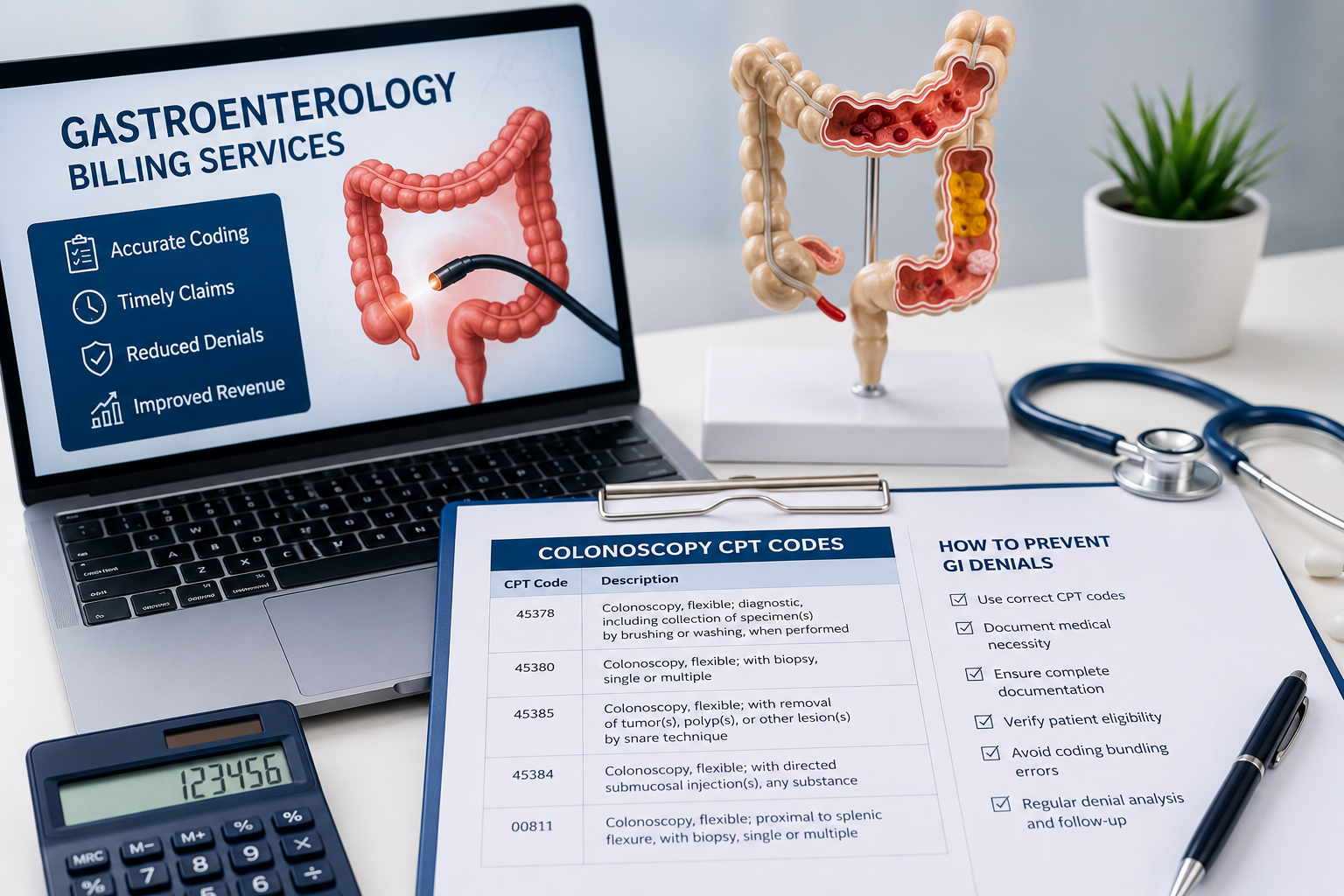
Colonoscopies are one of the highest-volume procedures in gastroenterology, and one of the most frequently mis-coded. A single visit can shift from screening to diagnostic mid-procedure, carry different rules depending on whether the payer is Medicare or a commercial plan, and involve multiple add-on codes for biopsies or polyp removal performed in the same session. Get any one of those pieces wrong, and the claim either underpays or bounces back as a denial.
For practices handling this volume in-house, the coding rules around screening-to-diagnostic conversions are often the single biggest source of billing confusion, and patient complaints, in the GI service line. Reliable gastroenterology billing services depend on getting this distinction right every time, not just most of the time.
This guide walks through the core CPT codes for colonoscopy and related GI procedures, breaks down the screening versus diagnostic distinction that trips up so many practices, and covers the denial patterns that show up most often in gastroenterology claims.
Why Gastroenterology Billing Carries More Risk Than It Looks Like
On the surface, colonoscopy billing looks simple: one procedure, one code. In practice, a colonoscopy can change classification in the middle of the exam. A patient scheduled for a routine screening may have a polyp found and removed in the same session, which shifts the procedure from preventive to diagnostic under CPT rules, even though the payer may still be required to cover it as preventive for cost-sharing purposes.
That gap between how a procedure is coded clinically and how it must be billed for cost-sharing is where most gastroenterology billing problems start. It also means the correct code, modifier, and diagnosis pointer can depend on details that only show up in the procedure note, not the original scheduling reason.
Add in payer-specific frequency rules, anesthesia billed as a separate claim, and bundling edits between the base procedure and add-on codes like biopsy or polypectomy, and a GI practice is managing considerably more billing complexity per encounter than most primary care visits.
Core CPT Codes for Colonoscopy and GI Procedures
Accurate reimbursement starts with selecting the code that matches exactly what was performed, not just the procedure type.
Diagnostic Colonoscopy (45378) — The base code for a colonoscopy performed to evaluate symptoms, follow up on prior findings, or as a diagnostic exam rather than a screening.
Colonoscopy with Biopsy (45380) — Used when tissue is sampled for pathology during the exam.
Colonoscopy with Polypectomy, Snare Technique (45385) — Used when a polyp is removed using a snare, one of the most common add-on scenarios during screening exams.
Colonoscopy with Polypectomy, Hot Biopsy Forceps (45384) — Used when a polyp is removed using hot biopsy forceps instead of a snare.
Medicare Screening Colonoscopy, Average Risk (G0121) — The HCPCS code for a Medicare screening colonoscopy performed on a patient who does not meet high-risk criteria.
Medicare Screening Colonoscopy, High Risk (G0105) — The corresponding HCPCS code for a Medicare screening colonoscopy on a patient with a personal or family history that qualifies as high risk.
Commercial payers generally use standard CPT preventive codes for screening colonoscopies rather than the Medicare G-codes, so the correct starting code depends on whether the payer is Medicare, Medicare Advantage, or a commercial plan. Confirming this before the claim goes out avoids a category of denials that has nothing to do with the clinical work performed.
The Screening vs. Diagnostic Distinction: Where Most GI Claims Go Wrong
This is the coding scenario that causes the most confusion in gastroenterology billing, and the one that generates the most patient billing complaints when it’s handled incorrectly.
A patient comes in for a routine screening colonoscopy with no symptoms and no personal history of polyps. During the procedure, the physician finds and removes a polyp. Clinically and procedurally, that colonoscopy is now diagnostic or therapeutic rather than purely preventive, and it gets billed with a code like 45385 instead of the screening code the visit was scheduled under.
Under the Affordable Care Act, though, a screening colonoscopy that converts to a polypectomy is still required to be covered as a preventive service for cost-sharing purposes on most commercial plans and, with some nuances, under Medicare. That means the patient should not be billed a deductible or coinsurance simply because a polyp was found and removed.
The fix is in the modifier, not the CPT code:
Modifier PT — Applied for Medicare claims when a screening colonoscopy converts to a diagnostic or therapeutic procedure, which waives the deductible under Medicare’s screening conversion rule.
Modifier 33 — Applied for most commercial payers to indicate the procedure began as a preventive service, which signals that ACA preventive cost-sharing protections should still apply even though the final CPT code reflects a polypectomy or biopsy.
Leaving these modifiers off doesn’t just risk a denial. It risks the claim paying correctly from the payer’s side while the patient still gets billed cost-sharing they were legally entitled to avoid, which shows up later as a billing complaint or appeal rather than an upfront rejection.
The diagnosis code order matters here too. A converted screening colonoscopy should still carry the screening diagnosis code (such as Z12.11) alongside the finding code, with the sequencing following the payer’s specific screening-conversion billing policy rather than a single standard order across all payers.
Common GI Billing Denial Triggers
Missing conversion modifiers. Modifier PT or 33 omitted on a screening colonoscopy that became diagnostic, leading to incorrect patient cost-sharing even when the claim itself pays.
Frequency and interval denials. Screening colonoscopy coverage intervals differ by payer and by risk category, generally around ten years for average risk and shorter for high-risk patients, and a claim submitted before that window resets gets denied for frequency.
Bundling and NCCI edits. Billing a biopsy and a polypectomy from the same session without the correct modifier can trigger a bundling denial, since payers may consider one procedure inclusive of the other unless properly distinguished.
Diagnosis code mismatches. Using a diagnostic diagnosis code on what should be billed as a screening claim, or the reverse, is one of the most common root causes of GI claim rejections.
Anesthesia claim misalignment. Anesthesia for a colonoscopy is typically billed on a separate claim from a separate provider, and if the anesthesia claim doesn’t carry the matching screening or conversion modifier, the patient can be billed differently for anesthesia than for the procedure itself.
Missing medical necessity documentation. Diagnostic colonoscopies billed without clear documentation of the presenting symptom or prior finding that justified a non-screening exam.
Best Practices for Maximizing Gastroenterology Reimbursement
Confirm screening eligibility and risk category before the procedure. Verifying the patient’s risk classification and last screening date ahead of time reduces frequency denials and clarifies which code family applies from the start.
Build conversion modifiers into the coding workflow, not as an afterthought. Coders should check every screening colonoscopy note for a polypectomy or biopsy finding and apply PT or modifier 33 as a standard step, not a manual exception.
Align anesthesia and facility claims with the GI claim. Anesthesia and facility billing should reflect the same screening-versus-diagnostic status and modifiers as the physician claim so the patient’s cost-sharing is consistent across all three.
Audit denial patterns by code and payer. Reviewing denials specifically for conversion modifiers, frequency, and bundling on a recurring basis helps a practice catch a payer’s shifting policy before it affects a large batch of claims.
Document medical necessity clearly for diagnostic exams. Every diagnostic colonoscopy claim should be traceable to a specific documented symptom, finding, or surveillance interval in the chart, not just a general referral reason.
Getting Colonoscopy Billing Right Protects Revenue and the Patient Relationship
Gastroenterology billing carries a layer of complexity that many other specialties don’t: a single procedure can change classification mid-visit, and getting the resulting modifier and diagnosis coding wrong doesn’t just risk a denial, it risks an unexpected bill landing on a patient who did everything right by scheduling a preventive screening.
Consistent, accurate coding across screening, diagnostic, and converted colonoscopy claims protects both the practice’s revenue and its relationship with patients who expect their preventive care to be covered as promised.
For a closer look at how a dedicated billing partner manages the full range of GI coding and claims, visit our Gastroenterology Billing and Coding Services page.
Ready to see where your practice may be losing revenue on GI claims? Get a GI Billing Audit from East Billing and find out.
