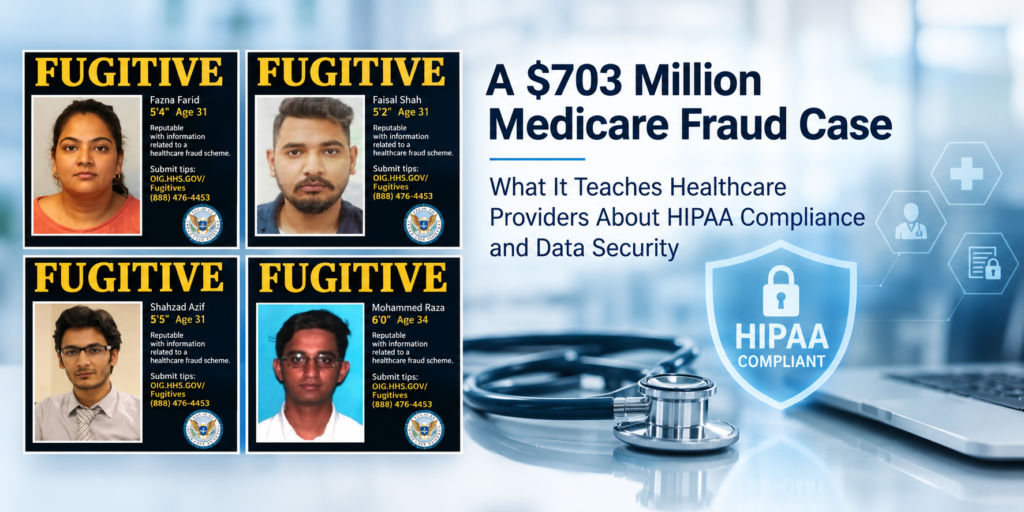
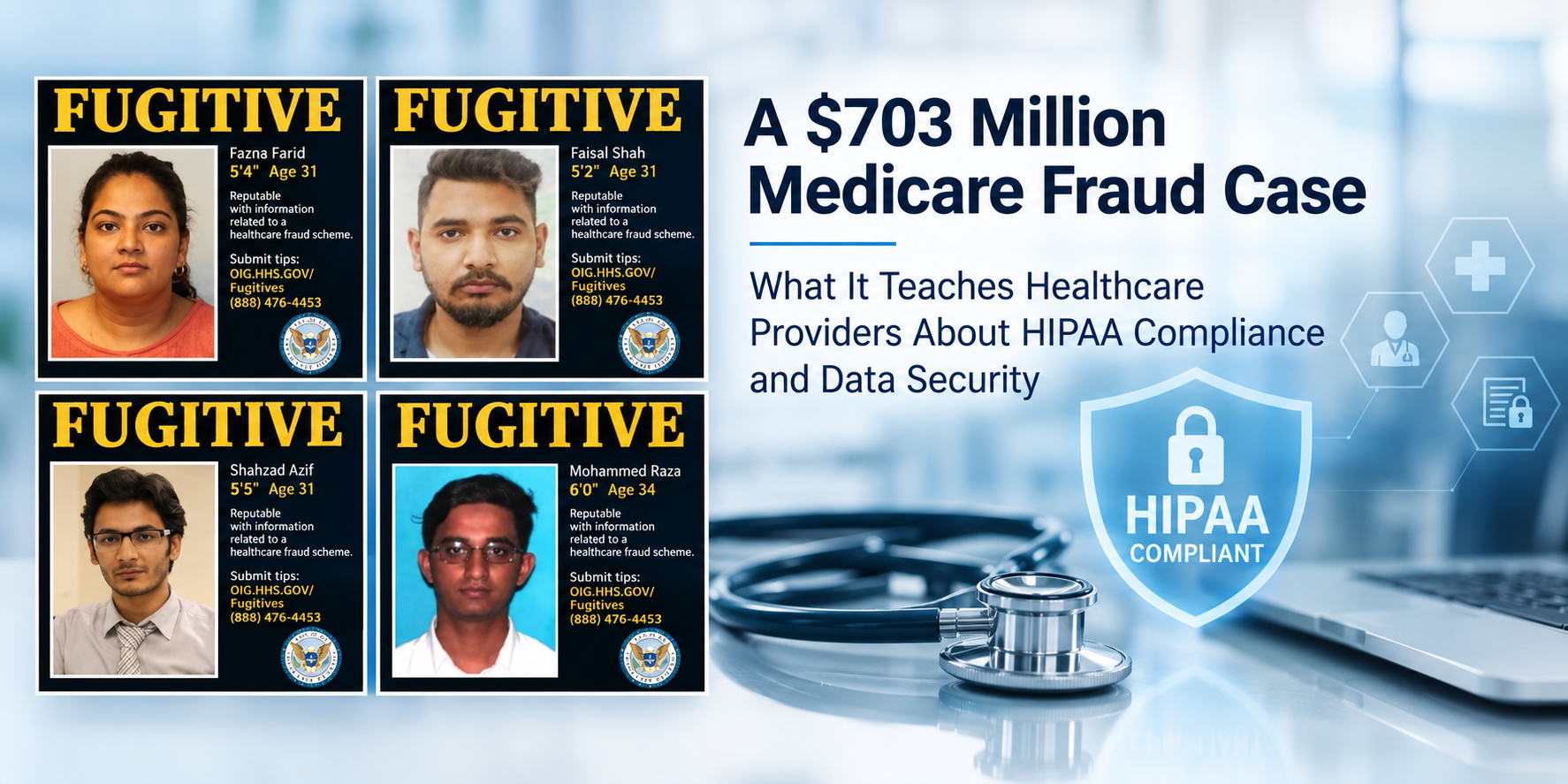
Healthcare organizations are facing a rapidly changing compliance environment in 2026. Patient information is increasingly digital, medical billing is more interconnected, and cybercriminals and fraud networks are finding new ways to exploit sensitive healthcare data.
A recent case involving approximately $703 million in alleged fraudulent Medicare claims demonstrates just how valuable patient and beneficiary information can become when it falls into the wrong hands.
According to the U.S. Department of Health and Human Services Office of Inspector General (HHS-OIG), four fugitives are currently wanted in connection with the alleged scheme. Investigators say a Pakistan-based call center obtained Medicare beneficiary information through theft and deception and that the information was subsequently used to support fraudulent claims.
The case is a serious reminder that healthcare organizations need to look beyond billing accuracy alone. Protecting patient information, controlling access to data, monitoring billing activity, and maintaining strong compliance procedures are all essential parts of a modern healthcare operation.
For healthcare providers, medical billing companies, and business associates, the question is not simply whether they are HIPAA compliant today. It is whether their entire workflow is designed to protect sensitive information as healthcare threats continue to evolve.
What happened in the $703 million Medicare fraud case?
The case was part of the U.S. Department of Justice’s broader healthcare fraud enforcement efforts.
Federal prosecutors allege that several individuals were involved in a scheme that resulted in approximately $703.8 million in false and fraudulent claims being submitted to Medicare and Medicare Advantage plans. The alleged claims involved products and services including over-the-counter COVID-19 test kits, durable medical equipment, and genetic tests that beneficiaries allegedly did not request, receive, or consent to receive.
According to prosecutors, Medicare and Medicare Advantage plans paid approximately $418.6 million on those claims.
Investigators allege that a Pakistan-based call center, Hello International Marketing Solutions, obtained Medicare beneficiary information through methods including hacking, scraping publicly available websites, and deceptive websites.
The alleged operation went further. Prosecutors say artificial intelligence was used to create recordings that purported to show Medicare beneficiaries consenting to receive certain products.
These allegations illustrate how healthcare data can become part of a much larger fraud operation when information is improperly obtained, shared, or exploited.
It is important to emphasize that these are allegations. The defendants are presumed innocent unless proven guilty in court.
Why this case matters for HIPAA compliance
The case is not simply a story about Medicare fraud. It highlights a broader healthcare data security issue.
HIPAA establishes federal standards designed to protect protected health information (PHI), while the HIPAA Security Rule specifically requires appropriate administrative, physical, and technical safeguards for electronic protected health information (ePHI).
For healthcare providers, that means protecting information should be part of the entire patient and billing lifecycle.
Consider how much information can pass through a typical healthcare organization:
- Patient names and contact information
- Dates of birth
- Insurance information
- Medicare or Medicaid identification information
- Medical histories
- Diagnosis information
- Treatment records
- Provider information
- Claims and billing data
- Payment information
- Medical documentation
When multiple employees, billing teams, software platforms, clearinghouses, vendors, and business associates interact with this information, every access point becomes important.
A compliance strategy therefore needs to address more than simply having a HIPAA policy sitting in an employee handbook.
1. Patient information must be treated as a high-value asset
Healthcare organizations often think about cybersecurity in terms of protecting systems from hackers.
That is important, but healthcare data itself is also extremely valuable.
A patient’s insurance or Medicare information can potentially be used to facilitate fraudulent billing, identity theft, or other forms of abuse.
The recent case demonstrates how stolen or improperly obtained beneficiary information can become an input into a larger fraudulent operation.
Healthcare providers should therefore ask:
Who has access to patient information?
Why do they need that access?
How is the information being transferred?
Where is it stored?
How long is it retained?
Who can download or export it?
What happens when an employee or contractor leaves?
These questions are fundamental to a strong HIPAA compliance program.
2. Access controls are critical
One of the most important elements of protecting PHI is controlling who can access it.
Employees should not automatically have access to every patient record simply because they work for a healthcare organization.
Access should be based on job responsibilities and business necessity.
For example, a billing employee may need access to insurance and claims information but may not need unrestricted access to every clinical record.
Healthcare organizations should consider implementing:
- Unique user accounts
- Role-based access
- Strong passwords
- Multi-factor authentication
- Automatic session timeouts
- Access reviews
- Restrictions on administrative privileges
- Immediate termination of access when employees leave
The goal is simple: employees should have access to the information they need to perform their responsibilities, but unnecessary access should be minimized.
3. Medical billing workflows need compliance controls
Medical billing is particularly sensitive because billing teams work with substantial amounts of patient and insurance information.
A billing workflow may involve patient demographics, payer information, diagnosis codes, procedure codes, claims documentation, medical records, authorizations, and payment information.
If those workflows are poorly controlled, sensitive information can be exposed unnecessarily.
A compliant medical billing process should incorporate security throughout the workflow, including:
- Secure data transmission
- Controlled employee access
- Appropriate documentation
- Secure storage
- Regular monitoring
- Employee training
- Vendor oversight
- Clear procedures for handling incidents
HIPAA compliance should therefore be considered part of the billing process rather than something separate from it.
4. Business associates matter too
Healthcare providers frequently work with outside organizations.
These may include:
- Medical billing companies
- Electronic health record vendors
- IT providers
- Cloud service providers
- Clearinghouses
- Consultants
- Practice management companies
- Other vendors that handle PHI
Under HIPAA, business associates that handle protected health information have important compliance responsibilities.
This means healthcare providers cannot simply assume that their own internal systems are secure.
They should also evaluate the vendors and partners that have access to their information.
Before working with a healthcare vendor, providers should consider:
Does the vendor have appropriate HIPAA policies?
How is PHI protected?
What security controls are in place?
Who can access the information?
Is a Business Associate Agreement (BAA) appropriate?
How are incidents reported?
What happens to PHI when the relationship ends?
Vendor oversight is increasingly important because one weak link can create risk for an entire healthcare organization.
5. HIPAA compliance requires ongoing risk assessment
HIPAA compliance is not a one-time project.
HHS guidance emphasizes the importance of conducting an accurate and thorough risk analysis of potential risks and vulnerabilities affecting the confidentiality, integrity, and availability of ePHI.
A risk assessment should consider both technology and human behavior.
For example:
- Are employees using outdated software?
- Are systems properly patched?
- Are former employees still able to access accounts?
- Are passwords being shared?
- Are sensitive files being sent through unsecured channels?
- Are employees trained to recognize phishing?
- Are vendors properly evaluated?
- Is patient information stored on personal devices?
- Are backups protected?
- Are unusual access patterns being monitored?
Regular risk assessments can help organizations identify weaknesses before they become incidents.
6. Employee training is just as important as technology
Even the most advanced cybersecurity tools cannot completely eliminate human error.
Employees may accidentally send information to the wrong recipient, click a malicious link, use weak passwords, download unauthorized software, or mishandle sensitive documents.
That is why HIPAA training should be ongoing.
Healthcare employees should understand:
- What constitutes PHI
- How PHI should be handled
- When information can be shared
- How to identify phishing attempts
- How to create and protect passwords
- Why credentials should never be shared
- How to report a suspected security incident
- How to securely communicate with patients and vendors
Training should not simply be a compliance formality. Employees should understand why these rules exist.
7. Monitor billing activity for unusual patterns
HIPAA compliance and fraud prevention are not identical, but they can overlap in important ways.
Healthcare organizations should have processes for identifying unusual billing activity.
Examples could include:
- Claims for services that were never provided
- Unusual increases in claim volume
- Duplicate claims
- Unexpected changes in payer mix
- Claims that do not match patient records
- Services that appear inconsistent with documentation
- Unusual access to patient accounts
- Large exports or downloads of patient information
Data analytics can play an increasingly important role in identifying unusual activity.
The federal government’s recent healthcare fraud enforcement efforts demonstrate how data analytics can help identify anomalous billing patterns. In one major 2025 takedown, HHS-OIG and CMS used data analytics to identify suspicious billing and prevent billions of dollars in scheduled fraudulent payments.
8. Healthcare organizations should prepare for evolving cybersecurity requirements
Healthcare cybersecurity expectations are becoming more demanding.
HHS proposed updates to the HIPAA Security Rule designed to strengthen cybersecurity protections for electronic protected health information. The proposed changes address the growing cybersecurity threats facing healthcare organizations and would introduce more specific security requirements for regulated entities.
Even when regulatory requirements evolve, the underlying principle remains consistent:
Healthcare organizations need to know where sensitive information exists, who can access it, how it is protected, and what happens if something goes wrong.
Organizations should therefore avoid treating HIPAA compliance as a static checklist.
A stronger approach is to build compliance into everyday operations.
9. Have a clear breach response process
Even organizations with strong security controls need an incident response plan.
If a potential breach occurs, employees should know exactly what to do.
The organization should have defined procedures for:
- Reporting suspected incidents
- Containing the incident
- Investigating what happened
- Determining what information was affected
- Documenting the incident
- Notifying appropriate parties
- Taking corrective action
- Preventing similar incidents in the future
HIPAA’s Breach Notification Rule establishes notification requirements for breaches involving unsecured protected health information.
A delayed or disorganized response can make an already difficult situation even more complicated.
10. HIPAA compliance protects more than patient information
It can be tempting to view HIPAA as a regulatory requirement that healthcare organizations simply need to satisfy.
In reality, effective compliance protects several important assets at once.
It helps protect:
Patients
Patients expect their personal and medical information to remain private.
Healthcare providers
Strong controls can reduce regulatory, operational, and reputational risks.
Revenue
Accurate billing and fraud prevention help protect legitimate healthcare revenue.
Business relationships
Hospitals, physicians, payers, and healthcare organizations increasingly expect vendors to demonstrate strong compliance and security practices.
Reputation
A healthcare organization can spend years building patient trust. A serious data incident can damage that trust quickly.
A practical HIPAA compliance checklist for 2026
Healthcare organizations can use the following checklist as a starting point:
| Area | Key question |
|---|---|
| Risk assessment | Have we identified current threats to PHI and ePHI? |
| Access control | Does every employee have only the access they need? |
| Authentication | Are strong passwords and MFA being used where appropriate? |
| Employee training | Are employees regularly trained on HIPAA and security? |
| Vendor management | Have our vendors been evaluated for HIPAA compliance? |
| Business Associate Agreements | Are appropriate BAAs in place? |
| Data transmission | Is PHI transmitted through secure channels? |
| Data storage | Is sensitive information properly protected? |
| Monitoring | Are unusual access and billing patterns monitored? |
| Incident response | Do employees know what to do if a breach occurs? |
| Breach procedures | Are notification and documentation procedures established? |
| Software security | Are systems patched and maintained? |
| Access reviews | Are user permissions reviewed regularly? |
| Offboarding | Is access removed promptly when employees leave? |
| Documentation | Are compliance activities properly documented? |
What healthcare providers should take away from the case
The $703 million Medicare fraud case should not be viewed simply as another fraud story.
It demonstrates the potential consequences when sensitive healthcare information becomes part of a larger criminal operation.
According to federal prosecutors, beneficiary information was allegedly obtained through hacking, scraping, and deceptive websites, then used in connection with fraudulent claims. The alleged operation also involved AI-generated recordings and the sale or use of beneficiary data.
For legitimate healthcare organizations, the lesson is clear:
Protecting healthcare data is part of protecting the healthcare business itself.
HIPAA compliance should extend beyond policies and paperwork. It should influence how employees access information, how vendors handle data, how billing is performed, how systems are monitored, and how incidents are handled.
How East Billing approaches compliant medical billing
For healthcare providers, managing billing internally can require significant time, resources, technology, and compliance oversight.
Working with an experienced medical billing partner can help practices establish structured billing workflows while maintaining appropriate safeguards for sensitive healthcare information.
At East Billing, our focus is on helping healthcare providers manage their revenue cycle while supporting secure, compliant processes.
From claims management and coding to billing workflows and revenue cycle support, the goal is to help providers spend less time dealing with administrative complexity and more time focusing on patient care.
As healthcare fraud and cybersecurity threats continue to evolve, compliance should remain an ongoing priority.
The healthcare organizations best positioned for the future will not simply react when a breach or fraud investigation occurs. They will build strong controls into their operations before a problem happens.
Final thoughts
The recent Medicare fraud allegations involving approximately $703 million in claims are a powerful reminder of the value of healthcare information and the sophistication of modern fraud schemes.
But healthcare providers do not need to wait for a major incident to evaluate their compliance practices.
Start with the basics:
Know what data you have.
Know who can access it.
Know where it goes.
Know which vendors handle it.
Monitor how it is being used.
Train the people who work with it.
And regularly reassess your risks.
HIPAA compliance in 2026 is not simply about checking boxes. It is about creating a healthcare environment where patient information, billing processes, and organizational systems are protected against increasingly sophisticated threats.
For healthcare providers, that is not just a regulatory responsibility. It is part of earning and maintaining patient trust.